Chapter 17 · 3 AM Again
How poor sleep actively worsens fatty liver — and what to do about it

3:14 AM.
Mark was awake. Not the gradual, drifting kind of awake — the kind where your eyes snap open and your heart is already running and the darkness of the bedroom feels like it's pressing in from all sides. His T-shirt was damp. The sheets felt wrong. Priya was breathing steadily beside him, the ambient sound of someone who could sleep through a Category 5 hurricane and wake up wondering why her hair was wet.
He lay still, waiting for the anxiety to identify itself. Market crash? Presentation disaster? Liver failing? Some new catastrophe his subconscious had assembled while he was unconscious?
Nothing came. There was no reason. He was just awake.
He'd been doing this for months. Before the diagnosis, he'd chalked it up to stress — too much caffeine, too many late emails, the ambient hum of being a marketing VP in a company that treated urgency as a personality trait. But the pattern had continued even as he'd cut caffeine to a single morning cup, even as the fasting and the Mediterranean diet and the daily walks should have been calming his nervous system into some version of equilibrium.
3:14 became 3:17. His mind was in that specific middle ground between awake and dreaming — replaying conversations from meetings that didn't matter, rehearsing responses to emails no one had sent, wondering whether his ALT was still dropping or if he'd somehow regressed despite doing everything right.
He got out of bed carefully, leaving Priya undisturbed, and went to the kitchen. The house was quiet in the particular way houses are quiet at 3 AM — the silence not empty but thick, like the air itself was holding its breath. He made chamomile tea because he'd read it was supposed to help, and sat at the counter with his phone.
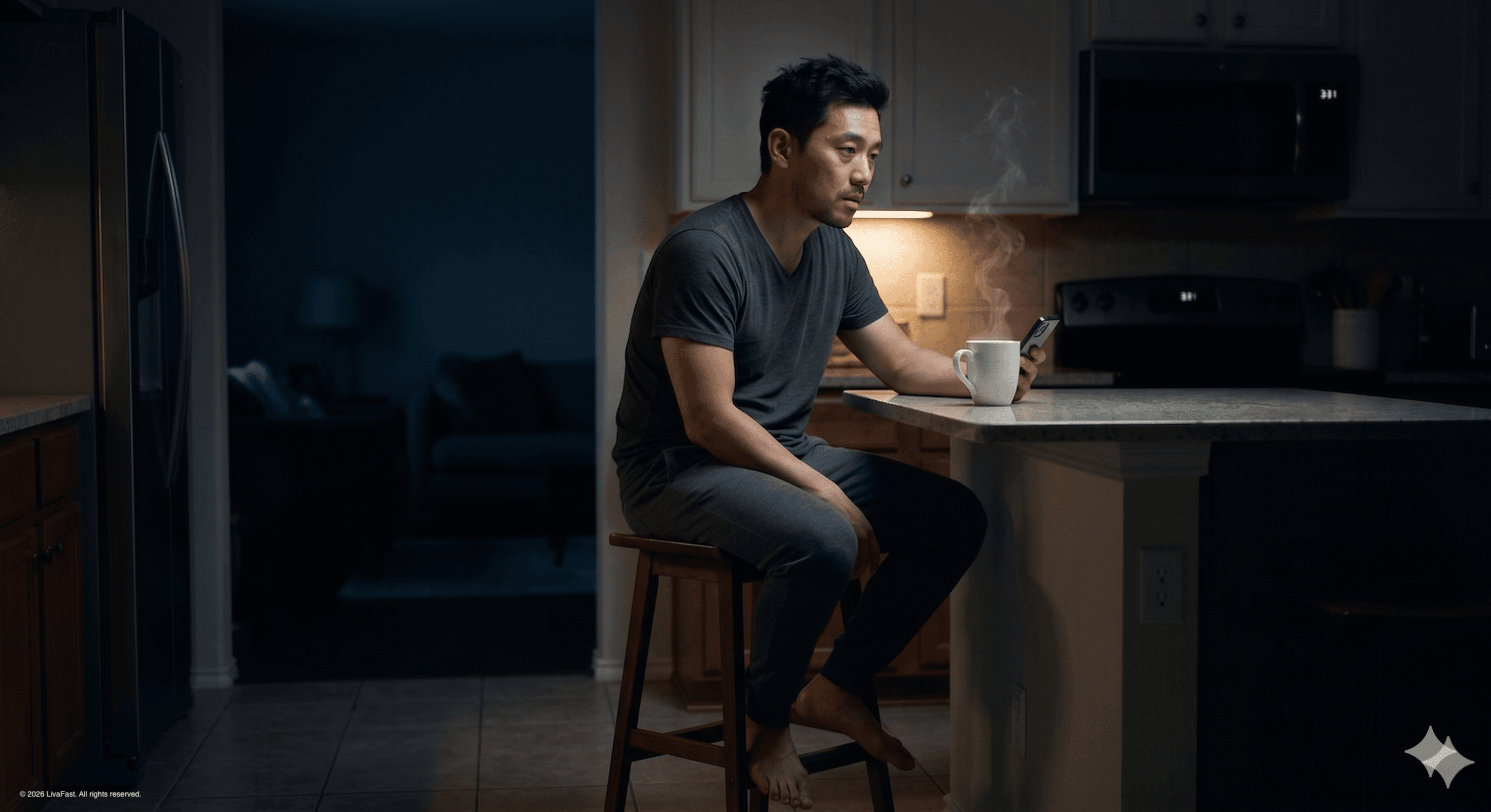
He shouldn't look at his phone at 3 AM. He knew this. The blue light, the stimulation, the inevitable slide into health-related Googling that would convert his vague 3 AM unease into specific 3 AM terror. He knew all of this.
He did it anyway.
He typed: "sleep deprivation fatty liver disease."
The first result was from a sleep medicine journal. The abstract was clear and, in the way of 3 AM research, immediately devastating:
Short sleep duration and poor sleep quality are independently associated with increased NAFLD risk, even after controlling for BMI, diet, and exercise. The effect was dose-dependent — patients getting fewer than six hours per night had substantially higher prevalence of advanced fibrosis.
Mark set the phone down.
He'd been so focused on the fasting. The diet. The exercise. The sugar. The alcohol. He'd been meticulous about what went into his body during the day. And his body was undoing it all at night.
The mechanism wasn't behavioural — it wasn't about midnight snacking or poor choices driven by fatigue. It was metabolic. Sleep disruption impaired the circadian regulation of hepatic glucose production, triglyceride synthesis, and lipid oxidation. Short sleep increased fasting glucose and triggered systemic inflammation that preferentially deposited fat in the liver.
He looked at the clock. 3:31 AM. He'd been awake for seventeen minutes, and his brain had already manufactured a new category of fear.
The worst part was that he couldn't tell if this was the disease or the anxiety about the disease. Maybe his liver was producing some inflammatory signal that disrupted his sleep. Or maybe his brain was simply broken in the way brains break when you spend three months worried about an organ you can't see or feel, and now everything — including the inability to sleep — had been absorbed into the narrative of his liver failing.
He went back to bed. Lay in the dark. Waited for 4 AM to become 5 AM to become the alarm.
At 5:47, Biscuit nudged his hand. Walk time. Mark's body moved on autopilot — shower, shoes, leash — while his mind was still half-asleep and entirely exhausted.
He'd mention this to Dr. Nguyen.
The appointment was two weeks later. Mark brought a printout — sleep data from his tracking ring, organized by date. He wasn't trying to be obsessive. He was trying to have evidence.
The data showed the pattern clearly: average of 5.8 hours per night over the previous two weeks. Frequent awakenings — two to three per night. Sleep score ranging from 58 to 72 out of 100. Deep sleep averaging only 20–25 minutes per night.
Dr. Nguyen looked at the printout with the expression of someone seeing a problem she'd expected.

"How long has this been going on?"
"Months. Before the diagnosis. It got worse after."
"That's actually important," she said. "Because poor sleep isn't a side effect of your liver condition. It's a driver. It's actively worsening your liver disease."
She turned to her computer and walked him through the mechanism. The liver had an internal clock — circadian clock genes called BMAL1, CLOCK, PER1, CRY1 — that were expressed in hepatocytes and synchronised by the sleep-wake cycle. During proper sleep, the liver was supposed to mobilise glycogen, suppress gluconeogenesis, and shift toward fatty acid oxidation. When that cycle was disrupted, the entire metabolic programme broke down.
"Your liver has a 24-hour rhythm," Dr. Nguyen said. "It's supposed to be doing specific metabolic work during sleep — work that supports everything else you're doing with fasting and diet. When you don't sleep, that rhythm fragments. Your liver stays in a confused metabolic state."
"And the inflammation?" Mark asked.
"Short sleep increases systemic IL-6 and TNF-alpha — the same inflammatory cytokines we've been trying to reduce with everything else. You're essentially working against yourself."
Mark felt something cold settle in his chest. He'd been so diligent. The fasting protocol was locked in. The Mediterranean diet was second nature. The walks were daily. The sugar was under control. And his sleep — the thing he'd treated as a nuisance, a personality quirk, a side effect of being a Type-A professional — was actively reversing his progress.
"What do I do?"
"First," Dr. Nguyen said, "we rule out sleep apnea."
Mark hadn't considered this. He didn't snore — or if he did, Priya hadn't mentioned it. But he did sometimes feel like he was suffocating at night, like his breathing would go shallow and then he'd gasp back to the surface. He'd assumed it was anxiety.
"The prevalence of obstructive sleep apnea in MASLD patients is extremely high," Dr. Nguyen continued. "Somewhere between 35 and 90 percent, depending on the population. And it's massively underdiagnosed because patients don't fit the stereotype. You don't have to be overweight or a loud snorer. Moderate apnea can present as exactly what you're describing — frequent awakenings, feeling suffocated, poor sleep quality despite adequate time in bed."
"And it affects the liver?"
"Each apnea event drops your blood oxygen. Repeated nocturnal hypoxaemia causes oxidative stress, mitochondrial dysfunction, and chronic inflammation — all of which deposit fat in the liver. It's a direct, independent driver of MASLD progression."
She ordered a home sleep study. Then she pulled out a notepad and wrote down what she called "the non-negotiables" — the sleep hygiene fundamentals that the evidence supported regardless of whether apnea was present.
Seven to nine hours of consistent sleep. Same bedtime, same wake time, every day including weekends — the circadian clock responded to timing more than total hours. Complete darkness in the bedroom — blue light in the evening suppressed melatonin synthesis. Cool room temperature, around 65 to 68 degrees — thermoregulation was tightly coupled to sleep onset. No caffeine after 2 PM. No alcohol — it felt sedating but fragmented sleep architecture. No eating within two to three hours of bedtime — late meals suppressed melatonin and could trigger reflux.
Mark looked at the list. He was already doing most of it — the caffeine timing was right, the alcohol was gone, the eating window closed by 6 PM. But his bedroom was warm. His phone charged on the nightstand. And his bedtime was inconsistent — sometimes 10 PM, sometimes midnight, depending on whether he was anxious or exhausted or both.
"Fix the consistency first," Dr. Nguyen said. "Your circadian clock can't synchronise if it doesn't know when you're going to sleep. Pick a bedtime. Stick to it. Even when you're not tired. Even on weekends."
That week, Mark made three changes.
He moved his phone charger to the kitchen. The first night, reaching for the nightstand and finding nothing there felt like a phantom limb. By the third night, he'd stopped reaching.
He set a bedtime alarm — 10 PM — that meant screens off, bedroom dark, body in bed whether his brain cooperated or not. The first few nights he lay awake for thirty or forty minutes, his mind performing its usual recital of worries. By the fifth night, the gap between lying down and falling asleep had narrowed to fifteen minutes.
He lowered the thermostat to 67. Priya, who ran cold, added a blanket to her side of the bed and said nothing, which was her way of supporting the intervention without editorialising.
By the end of the second week, his sleep data had shifted. Average duration: 6.8 hours, up from 5.8. Awakenings: one per night instead of three. Deep sleep: 45 minutes, up from 20. Not where it needed to be. But the trend was clear.
And the morning calm he'd first felt after that inaugural walk with Priya — the two minutes of quiet at 4:47 AM — started lasting longer. Five minutes. Ten. By the end of the second week, he woke up most mornings without the racing heart. Without the immediate inventory of anxieties. Just — awake. Rested. Ready to walk Biscuit and drink his coffee and start the day.
The sleep study results came back positive for mild obstructive sleep apnea. Dr. Nguyen prescribed a trial of positional therapy and nasal breathing exercises, with CPAP as a backup if symptoms didn't improve.
"This is treatable," she said. "And treating it will meaningfully improve your liver outcomes."
Mark added it to his protocol. Fasting. Diet. Exercise. Sleep. Four pillars, each one supporting the others, each one necessary. He'd been building a three-legged stool and wondering why it wobbled.
Now it had four legs. And it stood.
Fatty liver disease affects 38% of adults globally. Learn what MASLD is, why the name changed from NAFLD, and what you can do about it.
Track this in LivaFast
Your FIB-4 score updates automatically from your labs.