Chapter 18 · The Stress I Couldn't See
How cortisol quietly undoes everything — and how to break the cycle

The glass conference room on the fifth floor had the kind of aggressive air conditioning that made Mark's hands cold, which was unfortunate because his hands were also sweating. He sat at the table with his laptop open, PowerPoint queued, waiting for the executive team to file in. The Q2 product strategy pitch — the one that had consumed three weeks of his brain — was about to happen. The budget was substantial. The roadmap was ambitious. And if it went badly, there were questions about whether his new VP title would survive the quarter.
His heart was beating harder than the situation warranted. He knew this. He'd presented to these people before. He knew them. The CEO was reasonable. The CFO was thorough but fair. The CPO liked his work. This was not a firing squad. This was a meeting with colleagues about a marketing strategy, and his nervous system was registering it as a threat to his physical survival.
His mouth was dry. He took a sip of water and started.
Fifteen minutes in, something shifted in his abdomen. A pulling sensation on his right side — not sharp, but present. Insistent. He recognised it from before the diagnosis: his liver. Or what he was convinced was his liver. A body sending him a message he couldn't decode — was this inflammation? Was this the disease progressing? Or was this his nervous system throwing a tantrum and selecting the organ he was most afraid of as the location for its protest?
He pushed through. Made his points. The team asked questions. He answered them with the part of his brain that still functioned professionally while the rest of it catalogued symptoms and predicted catastrophe. Around the twenty-five-minute mark, the pulling eased, and he could almost breathe normally.
The CEO nodded when it was over. "Great work, Mark. Let's move forward."
Mark should have felt relief. Instead, he felt hollowed out. Scraped clean. Like the presentation had cost him something physical — not calories or energy, but some deeper reserve that he didn't know how to replenish.
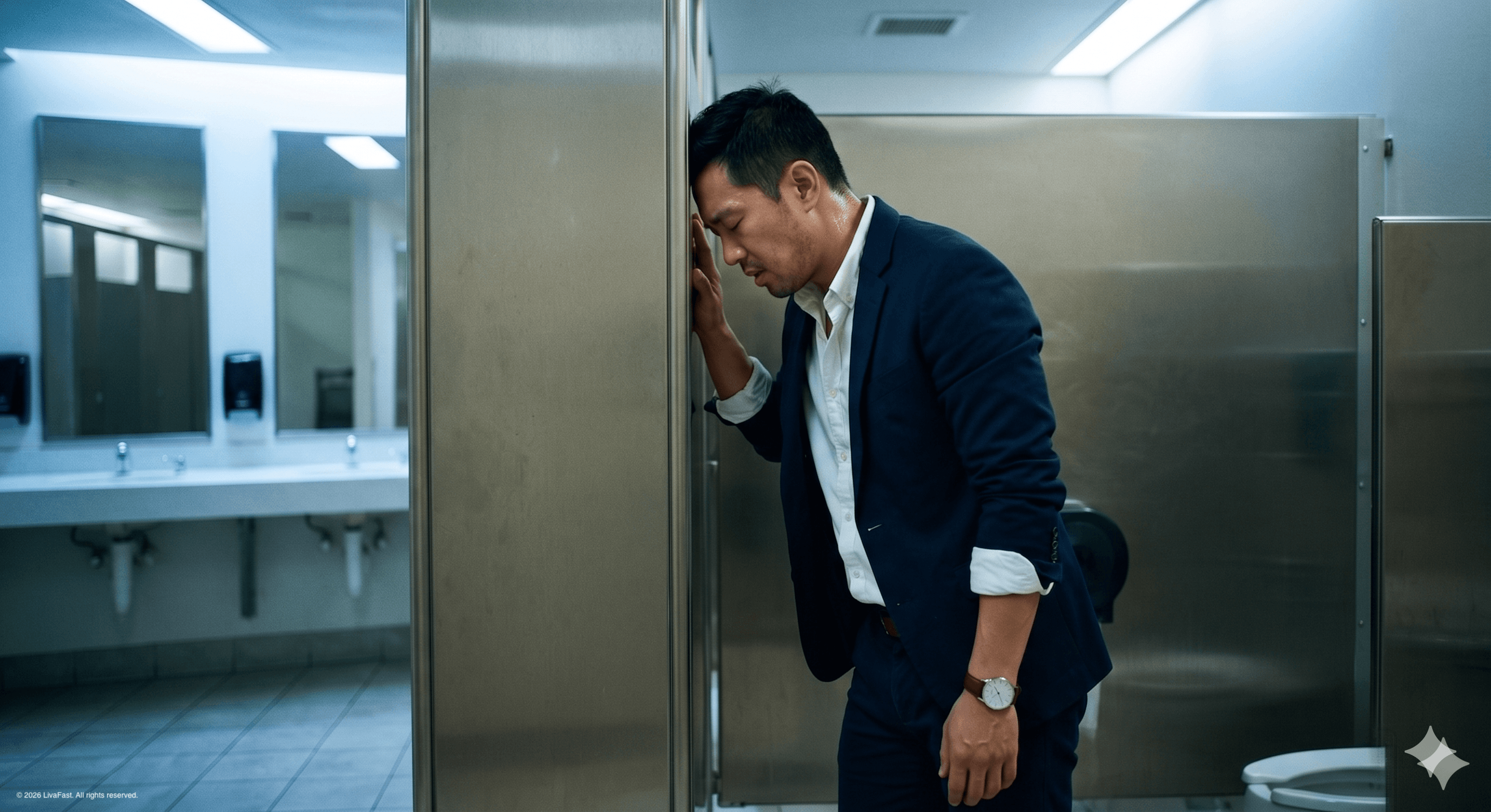
He excused himself, walked to the men's room, and locked himself in a stall. His heart was still racing. The right-sided ache lingered. And there was a feeling he couldn't name — something between terror and guilt — sitting in his chest like a stone he'd swallowed.
What if the fasting and the diet and the walks aren't working? What if the stress is reversing everything?
He stood there, forehead against the cool metal of the stall divider, and tried to slow his breathing. But his breathing wouldn't slow, because his brain wouldn't tell his nervous system the danger had passed. The danger, as far as his hypothalamus was concerned, had not passed. The danger was ongoing. The danger was his liver, his career, his mortality, the ambient catastrophe of being a 34-year-old man with a chronic disease and a high-pressure job and a body that wouldn't stop sending distress signals.
By the end of the day, Mark had convinced himself that his next lab results would be terrible. The stress had undone his weeks of progress. His ALT was probably back at 78. His liver was probably inflamed again. The pitch had actually gone poorly — he'd just been too stressed to perceive the failure clearly — and he was probably going to be fired, which meant he'd lose insurance, which meant he couldn't see Dr. Nguyen, which meant —
He sat in traffic on Congress Avenue with his foot on the brake and his jaw clenched so tight his molars ached, and he realised he was spiralling. The thoughts were building on each other, each one a brick in a wall between him and the rational part of his brain that knew — knew — the pitch had gone well, the labs were trending in the right direction, his job was secure.
But knowing and feeling were different things. And his body was feeling something his mind couldn't override.
This, he would later understand, was the problem he couldn't see.
Two weeks later, on a Saturday morning, Mark was sitting at the kitchen table with his coffee when Priya set her phone down and said something that made him go very still.
"I read something," she started, with the particular care she used when delivering information she suspected would land hard. "About stress and NAFLD."
"Okay," Mark said, which meant: I'm not sure I want to hear this, but I know you're going to tell me anyway.
"Higher perceived stress is independently associated with NAFLD presence and severity. Even after they controlled for BMI, diet, exercise — all of it. The stress by itself increases liver fat."
Something cracked in Mark's chest. A hairline fracture in the framework he'd been building for weeks — the careful architecture of interventions, each one stacked on the next, each one documented and tracked and believed in. He'd assumed that doing the right things would be enough. That the inputs — fasting, diet, exercise, sleep — would produce the output — a healed liver — as long as he was diligent enough.
"So I can do everything right —"
"And if you're stressed, you still accumulate liver fat," Priya finished. "Which is genuinely unfair, because part of the stress is about having the disease in the first place."
They sat with that for a moment. The unfairness of it. The recursion.
"But here's the mechanism," Priya continued, because she always continued. "Chronic stress increases cortisol. Cortisol increases glucose production. Glucose production increases insulin. Insulin deposits fat in the liver. It's not just psychological — it's a direct metabolic pathway from your nervous system to your hepatocytes."
Mark thought about the conference room. The racing heart. The right-sided ache that probably wasn't his liver at all but his nervous system choosing the organ he feared most as the staging ground for its alarm. He thought about the traffic on Congress Avenue. The clenched jaw. The catastrophic thinking that had built a collapsing future out of a meeting that had actually gone well.
"So I need to un-stress," he said.
"You need to manage your stress," Priya corrected. "Specifically. Intentionally. As an intervention, not a vague aspiration."
He'd been trying to heal his liver by changing his behaviour — what he ate, when he ate, how much he moved. But he hadn't been trying to change the nervous system that controlled the behaviour. The thing that woke him at 3 AM. That made his heart race in meetings. That convinced him he was failing even when he was succeeding. That filled his body with cortisol — the hormone that told his liver to make fat — even as he was doing everything in his power to make his liver stop.
That was the thing he'd missed. The invisible fifth pillar.
That afternoon, Mark sat with his laptop and read about cortisol and the liver. The research was less ambiguous than he'd expected.
One study had followed over 4,000 patients without baseline NAFLD and found that those in the highest quartile of perceived stress had 3.5 times higher risk of developing the disease over the follow-up period. The association remained significant after controlling for BMI, waist circumference, physical activity, and dietary quality. Stress alone — independent of every other factor — tripled the risk.
The mechanism was a cascade. Chronic stress activated the HPA axis — the hypothalamic-pituitary-adrenal system — producing sustained cortisol elevation. Unlike the normal diurnal pattern (cortisol high in the morning to mobilise energy, low at night to promote sleep), chronic stress flattened the curve, leaving cortisol elevated throughout the 24-hour cycle.
And elevated cortisol did four specific things to the liver:
It enhanced gluconeogenesis — stimulating the enzymes that converted amino acids to glucose, raising fasting glucose and contributing to the hyperinsulinemia that drove steatosis. It suppressed glucose uptake by impairing the translocation of glucose transporters to cell membranes, worsening insulin resistance. It preferentially drove fat deposition into visceral adipose tissue — the metabolically toxic depot around the organs — which then released inflammatory cytokines and free fatty acids directly into the portal circulation, straight to the liver. And it upregulated SREBP-1c, the transcription factor that coordinated hepatic fatty acid synthesis. Even without increased food intake, the liver began storing more fat.
Four mechanisms. All driven by a single hormone. All activated by Mark sitting in traffic with his jaw clenched, convinced the world was ending.
But cortisol didn't work in isolation. It cascaded through every other system Mark was trying to protect.
It broke down the gut barrier — increasing intestinal permeability, allowing bacterial endotoxins into the bloodstream, triggering the hepatic inflammation he was fighting with olive oil and omega-3s. It impaired sleep — dysregulating melatonin and disrupting the circadian clock genes that governed hepatic lipid metabolism. His 3 AM awakenings weren't just anxiety. They were cortisol-driven HPA activation, waking him because his body thought there was a predator in the room. It shifted his immune system toward a pro-inflammatory profile — elevating the same TNF-alpha and IL-6 that his Mediterranean diet was trying to suppress.
And then there were the behavioural effects that closed the loop: stress made people seek comfort food, skip exercise, stay up late, drink more. Mark had managed to avoid most of these through sheer discipline — but discipline was a finite resource, and cortisol was the thing draining it.
He closed the laptop and sat in the kitchen. The knowledge settled like the other revelations had — not as a crushing weight, but as a clarification. Another piece of the map filling in. Another intervention to add to the protocol.
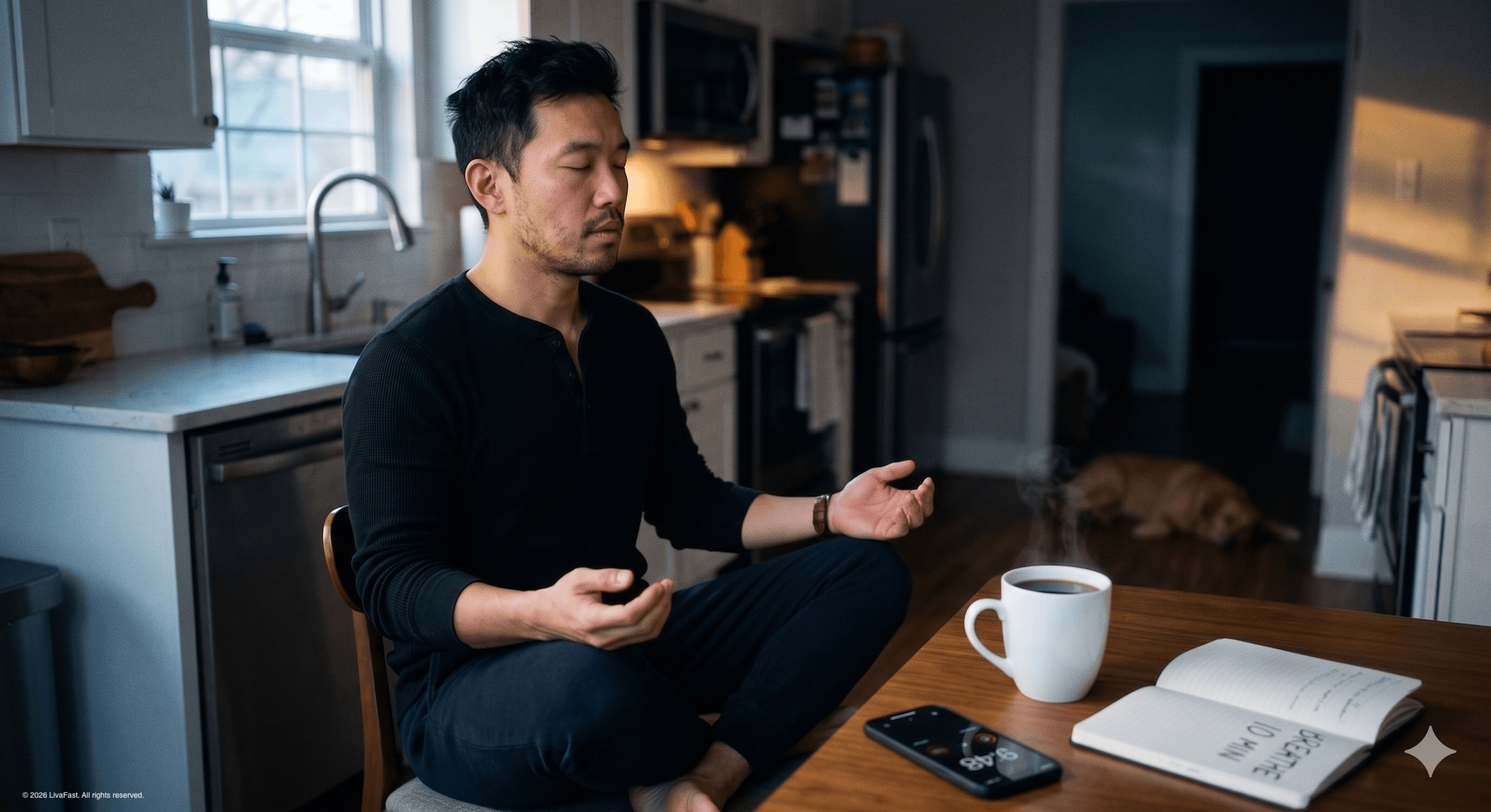
That evening, he started a ten-minute breathing practice. Six seconds in, eight seconds out. He sat at the kitchen table before dinner, phone off, and did it while Biscuit slept on the couch and Priya read in the next room. The first three minutes felt performative — like pretending to meditate in a movie about someone who meditates. But somewhere around minute five, something shifted. His heart rate dropped. Not dramatically, but perceptibly. The tension in his jaw released. The ambient hum of worry that had become his baseline operating state — so constant he'd stopped noticing it — quieted.
Not silenced. Quieted. Like turning the volume down on a radio that had been playing static for months.
He checked his watch afterward. Resting heart rate: 62. It had been 68 that morning after the traffic. Six beats per minute, recovered in ten minutes of breathing.
He set a daily reminder for 7 AM: BREATHE 10 MIN. And the next morning, he did it before his walk, sitting at the kitchen table with his coffee cooling beside him, six seconds in, eight seconds out, while the house was quiet and the dog was sleeping and no one needed anything from him.
It was the smallest intervention he'd made. It became the one that changed the most.
Fatty liver disease affects 38% of adults globally. Learn what MASLD is, why the name changed from NAFLD, and what you can do about it.
Track this in LivaFast
Your FIB-4 score updates automatically from your labs.