Chapter 16 · The 30-Minute Walk That Changed My Labs
Why movement is direct liver medicine — even without weight loss

Mark's shoes felt heavier than they should have. Week eight of his reset, and he'd dialled in the fasting — 16:8, almost effortless now, the hunger that had once dominated his mornings barely registering. The Mediterranean diet had started tasting less like medicine and more like food he actually wanted to eat. His kitchen no longer felt like a minefield. His sugar intake was under 25 grams. His coffee was black and deliberate and working on four mechanisms simultaneously.
But there was the small problem of movement. Which he'd been successfully, systematically avoiding.
He was sitting on the couch at 6 PM on a Tuesday — the posture of a man who had optimised everything except the part that required standing up — when Priya walked through the door with Biscuit's leash coiled in her hand and a look on her face that Mark recognised as the one she used in client meetings when negotiation was no longer on the table.
"You're coming," she said. Not a question.
"I have emails," Mark said. This was technically true and completely insufficient as an argument.
"You have legs." She didn't break stride. "Mark, you're fasting, you're eating better, your energy is up — but you're literally sedentary eight hours a day at work, then sedentary at home. Your hepatologist said movement matters."
This was also technically true. Dr. Nguyen had mentioned it at his last appointment, the way doctors mention things they suspect you'll ignore but feel professionally obligated to say.
"I go to the gym," Mark offered, with the conviction of someone producing an alibi that wouldn't survive cross-examination.
"You haven't been to the gym since week two. You have memberships to three different gyms, by the way. I found the credit card statements."
Biscuit whined — a precise, theatrical sound that he deployed exclusively when walks were being discussed and humans were being slow about it.
Mark was formulating a counter-argument involving the diminishing marginal utility of exercise relative to his current metabolic interventions, but Priya was already moving toward the bedroom to change shoes, and Biscuit was performing the full-body wiggle of a dog who had won. Outmanoeuvred by a woman and a beagle. Story of his life.
Twenty minutes later, Mark was standing on a sidewalk in a South Congress neighbourhood he'd driven through a thousand times but never actually walked. The temperature was dropping into the low seventies. Live oaks threw long shadows across the pavement. Somewhere, a grackle was arguing with another grackle about something that clearly mattered to grackles. And Mark's calves were already burning.
"We're only three minutes in," Priya said cheerfully, which meant she could see him wincing.
"My body is telling me it's angry," Mark said.
"Your body is telling you it's alive. There's a difference."
They walked in silence for a while. Biscuit pulled gently at the leash, leading them toward smells that apparently only dogs could appreciate — fence posts, drainage grates, a specific patch of dirt that demanded a full ninety seconds of investigation. Mark's phone was tucked away — Priya had insisted — so there was nothing to do but feel the evening, the soreness creeping through muscles he'd forgotten he had, and the unexpected, disarming calm that came from moving his body after weeks of mostly not.
"How are you feeling?" Priya asked at the fifteen-minute mark.
"Like I'm dying," Mark said.
"You're not dying. You're exercising."
"Same thing."
But something was shifting. His breathing had stabilised. The burning in his calves had become background noise — present but no longer alarming. And somewhere along the trail near Lady Bird Lake, while Biscuit was conducting a forensic analysis of a particularly interesting patch of grass, Mark realised he wasn't thinking about work. He wasn't thinking about his ALT or his HOMA-IR or whether his liver fat percentage had dropped. He wasn't thinking about anything. He was just walking. Feet on pavement. Air in lungs. The simple mechanics of a body in motion.
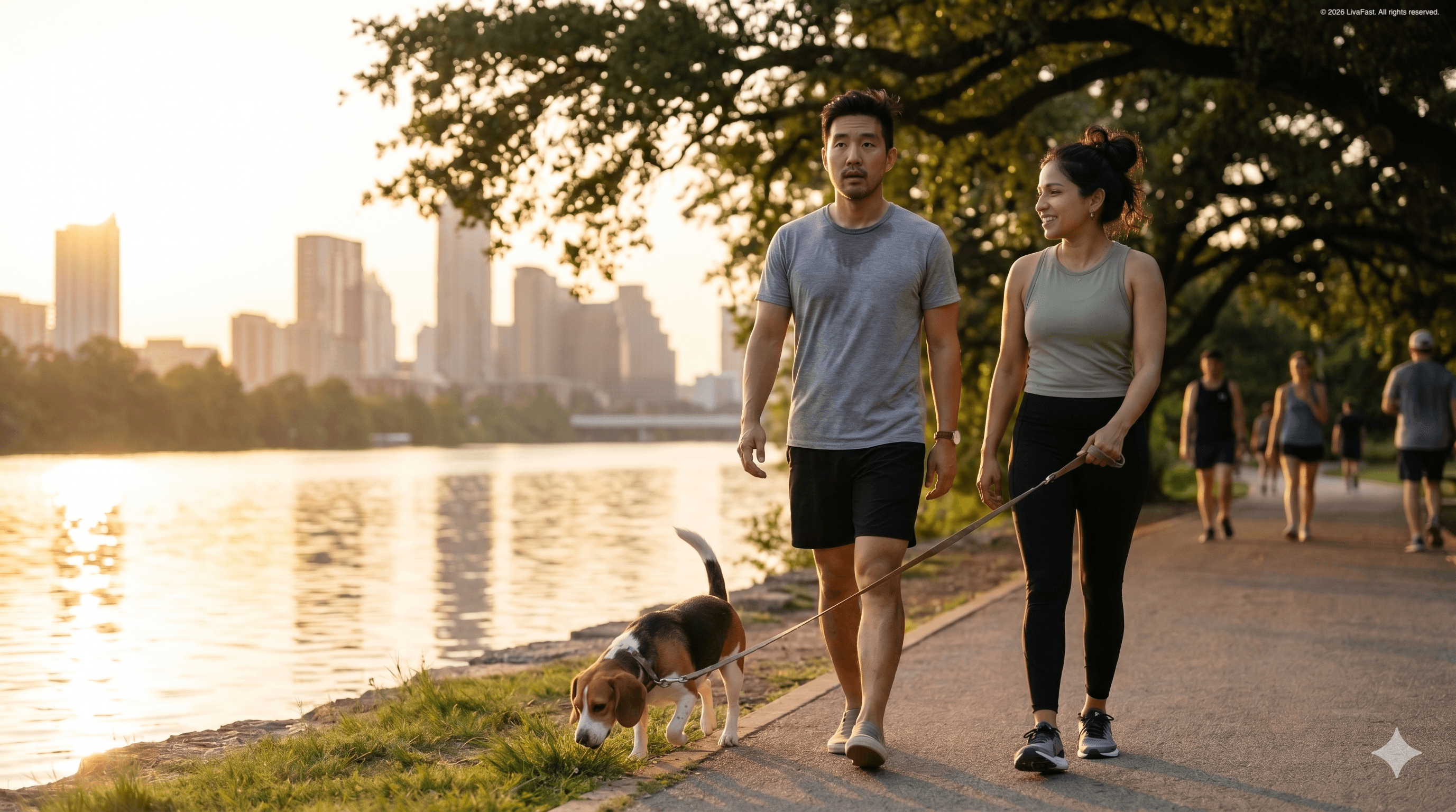
They did the loop. Thirty minutes, door to door. When they got home, Mark's shirt was damp and his legs felt like they'd been replaced with something less structurally sound, but the strange thing was — he felt calm. Not the satisfied calm of accomplishment or the smug calm of checking a box. A deeper calm. The kind that settled into his nervous system like something had been reset.
He showered. He made dinner. He fell asleep without checking his email.
And the next morning, something unexpected happened.
It was 4:47 AM. Mark was awake. But he wasn't awake with racing thoughts. He wasn't staring at the ceiling, constructing worst-case scenarios, rehearsing the anxiety that had been his default alarm clock since the diagnosis. He was just — awake. Quiet. The room was dark and still and his nervous system was, for once, not performing its usual predawn symphony of cortisol and catastrophe.
It lasted two minutes. Then the anxiety tried to reassert itself, the familiar hum of what if it's worse, what if the labs don't improve, what if I'm not doing enough. But those two minutes of quiet had been real, and they felt like evidence. Evidence that something in his physiology — not his psychology, his physiology — had shifted.
He got up and walked Biscuit before work. A short fifteen-minute loop around the neighbourhood. The air was cool and the streets were empty and the dog was ecstatic.
It became a thing.
By week nine, the walk was no longer Priya's idea. It was Mark's. He walked Biscuit every morning before work — fifteen to twenty minutes — and again in the evening with Priya for thirty minutes. Forty-five to fifty minutes of daily movement, most of it walking at a pace that was conversational but required effort. His calves had stopped burning. His resting heart rate, which he tracked on his watch, had dropped from 68 to 58 over the past three weeks.
And then, at breakfast on a Saturday, Priya mentioned something that changed his mental model entirely.
She was reading an article on her phone and said it casually, the way you mention something interesting you've read, not realising you're about to shift someone's understanding of their own recovery.
"It says here that exercise reduces liver fat independently of weight loss. Like, you could stay the same weight and the exercise alone would shrink your liver fat."
Mark set down his coffee. "What?"
"Yeah, look." She turned the phone around. The abstract was dense with clinical language, but the finding was unambiguous: a randomised controlled trial showing that aerobic exercise significantly reduced intrahepatic triglycerides without requiring weight loss.

Something tilted in Mark's head. He'd been thinking of exercise as a weight-loss tool — slow, frustrating, and subordinate to the fasting and diet that were doing the real metabolic work. But if exercise was directly healing his liver, right now, even as he stayed roughly the same weight, then it wasn't about the scale at all. It wasn't about vanity metrics or burning calories to justify what he ate.
It was direct liver medicine.
He thought about the 30-minute walk. The calm that followed. The two good hours of sleep. The morning quiet. The way Biscuit's leash had become a cue that required zero willpower because the dog's enthusiasm did all the motivational work.
Movement wasn't punishment. It was a conversation between his body and his liver. And his liver was listening.
That afternoon, Mark read the full paper and then three more. The evidence was overwhelming and specific in a way that made him wish he'd started walking in week one.
Aerobic exercise — even moderate, even just walking — directly reduced the fat stored inside liver hepatocytes. In controlled studies, patients who exercised without intentional calorie restriction achieved 20–25% reductions in intrahepatic fat content. The mechanism was elegant: exercise forced muscles to become more energy-demanding, which increased their oxidative capacity. More metabolically active muscles became better sinks for circulating fatty acids — fatty acids that would otherwise be re-esterified in the liver. The muscles were literally pulling fat away from the liver by becoming hungrier for fuel.
And the insulin effect was immediate. Even a single 30-minute aerobic session increased GLUT4 translocation — moving glucose transporters to the surface of muscle cells, improving glucose uptake without requiring insulin signaling. Over weeks, this became chronic: muscles expressed more glucose transporters, insulin receptor density increased, and the signaling pathway became more responsive. The hyperinsulinemia that had been driving Mark's hepatic fat accumulation was being addressed not just by fasting (which lowered insulin by removing food) but by exercise (which improved insulin sensitivity by making cells respond better).
Two interventions. Same target. Different mechanisms. Synergistic.
He texted Dave: "Did you know exercise reduces liver fat even without weight loss?"
"Yeah. Muscle is a metabolic sink. The more muscle you have, the less your liver has to store."
"Why didn't you tell me to start walking in week one?"
"I told you to start walking in week one. You said you had emails."
Fair point.
That evening, Mark and Priya walked the long loop — forty minutes along the lake trail, Biscuit ranging ahead and circling back, the Austin sunset doing its usual extravagant performance across the water. Mark's legs felt strong. Not because they were — he was still deconditioned, still feeling the weeks of sedentary accumulation — but because they were responding. The soreness was gone. The breathing was easy. The calm came faster now, settling in by minute ten instead of minute twenty.
"I want to add resistance training," he said.
Priya looked at him. "Mr. Three-Gym-Memberships-No-Attendance wants to lift weights?"
"The research says combining aerobic and resistance training is better than either alone. Resistance training builds muscle mass, which increases basal metabolic rate and creates a larger sink for glucose and fatty acids. Aerobic training oxidises fat directly and improves cardiorespiratory fitness. Together they're synergistic."
"You're quoting a paper at me."
"I'm quoting the European Association for the Study of the Liver. They recommend 150 to 300 minutes of moderate aerobic exercise per week, plus resistance training."
"And you're already at about 300 minutes of walking. So the resistance is the next step."
"Two to three sessions a week. Compound movements. Thirty to forty minutes."
Priya smiled — the real one, the proud one. "Okay. I'll find us a programme."
"You don't have to —"
"Mark. I've been waiting for this conversation for eight weeks. Let me have this."
He laughed. The first genuine, full-bodied laugh in longer than he could remember. Biscuit, interpreting the sound as an invitation, jumped up and placed both paws on Mark's thigh.
"Everyone's excited," Priya observed.
Everyone was.
Fatty liver disease affects 38% of adults globally. Learn what MASLD is, why the name changed from NAFLD, and what you can do about it.
Track this in LivaFast
Your FIB-4 score updates automatically from your labs.