Chapter 12 · The Fridge Purge
A kitchen overhaul — what to embrace, what to remove, and why abundance wins
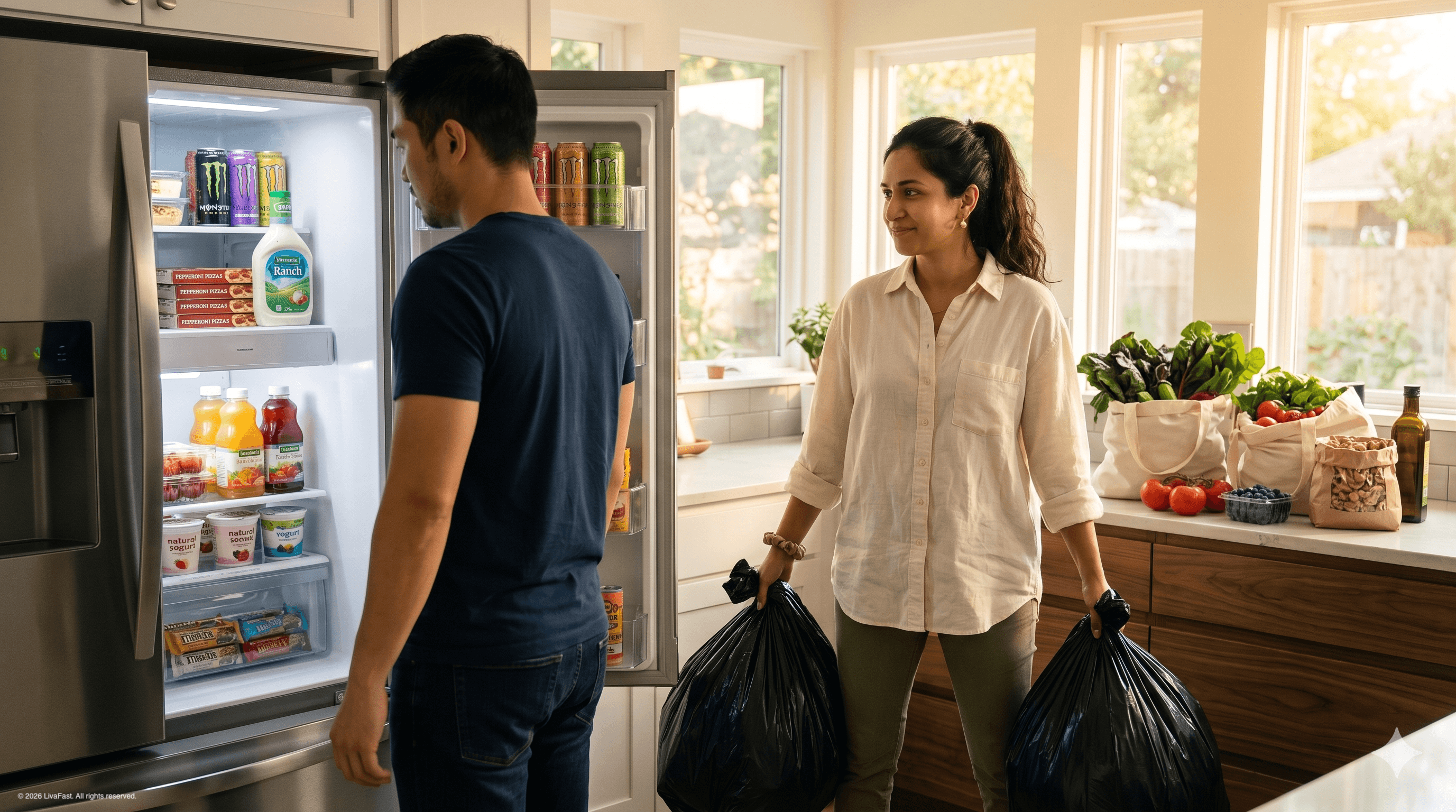
Saturday morning arrived with the kind of Austin sunlight that made you want to throw open every window and reconsider your entire relationship with indoor living. Mark had declared it — with Priya's enthusiastic co-sign — as "Fridge Day." Not the kind where you toss the expired yogurt and wipe down the shelves. The kind where you interrogate every item like a detective who already knows the answer.
Priya appeared in the kitchen carrying two industrial trash bags. She held them at her sides like a gunslinger. "Ready?"
Mark opened the refrigerator. It looked like a convenience-store diorama assembled by someone who'd given up on the future. Three energy drinks lined up in the door like plastic soldiers. A bottle of ranch dressing the size of a small fire extinguisher. Frozen pepperoni pizzas stacked in the freezer. Three bottles of fruit juice. A container of yogurt with a label that said "natural" and a nutrition panel that said 24 grams of sugar.
"Jesus," Mark said quietly.
"Yeah," Priya agreed. "Okay. Here's the system. Left side of the counter: everything you're keeping. Right side: everything you're saying goodbye to." She pulled a crumpled piece of paper from her back pocket — his checklist from last week, now annotated in her tidy blue handwriting. "The embrace list is longer than the avoid list. Way longer. So this should feel like expansion, not loss. Got it?"
Mark nodded. He was oddly emotional about the trash bags, in a way he couldn't fully articulate. The fridge contained the physical evidence of how he'd been eating for years — the choices that had accumulated, invisibly, into the fat in his liver. Standing in front of it felt like standing in front of a map of the problem.
They started with the energy drinks. Mark had been telling himself they were just caffeine — a 3 PM pick-me-up for the afternoon fog that he now understood was insulin-driven. He pulled one out and read the label. Fifty-four grams of sugar. The can felt different in his hand, heavier, as if the information had changed its weight.
"Trash," Priya said. Kindly, but firmly. One by one, the cans went into the bag.
The ranch dressing was harder. Mark loved ranch dressing the way some people loved their childhood blanket — irrationally, undefensibly, and with no intention of stopping. He'd been putting it on salads, using it as a dip for carrots (which he'd told himself counted as healthy eating), and occasionally drinking it off a spoon at midnight. He held the bottle up and read the ingredient list: soybean oil, buttermilk, eggs, MSG, artificial flavours.
"Goodbye, old friend," he said, and placed it gently in the bag with the solemnity of a burial.
The frozen pizzas went straight. The fruit juices followed — thirty-two grams of sugar in a twelve-ounce bottle, no fibre, none of the phytonutrients that made actual fruit worth eating. Just fructose in a container, delivered directly to a liver that was already drowning in triglycerides.
But then Priya started pulling things out of grocery bags and setting them on the counter's left side. Dark leafy greens in a clamshell container. A bag of raw almonds. Cans of wild salmon. Full-fat Greek yogurt — high protein, low sugar, no added sweeteners. Blueberries, fresh, in a small carton that probably cost more than the frozen pizzas.
"This," Priya said, holding up the blueberries, "is what we're pivoting toward." She tapped her annotation on the checklist. "The avoid list is maybe ten things. Fifteen if you count variations. The embrace list?" She gestured at the counter, which was becoming a still life of actual food. "Over thirty items. We're not taking things away, Mark. We're gaining protective compounds your liver literally needs to function."
Mark looked at his emptied fridge. Then at the counter covered in possibility. Something shifted — the same shift he'd felt when the name changed from NAFLD to MASLD, when the framing moved from judgment to biology. This wasn't about what he'd lost. It was about what he was building.
By noon, the fridge was transformed. Shelves of vegetables — spinach, kale, arugula, bok choy. Containers of legumes he'd never cooked with until last week — white beans, green lentils, chickpeas. A bottle of serious olive oil, the kind with a harvest date on the label. Fresh herbs in small pots on the windowsill. Eggs, cheese, yogurt. Actual salmon fillets wrapped in paper from the fish counter.
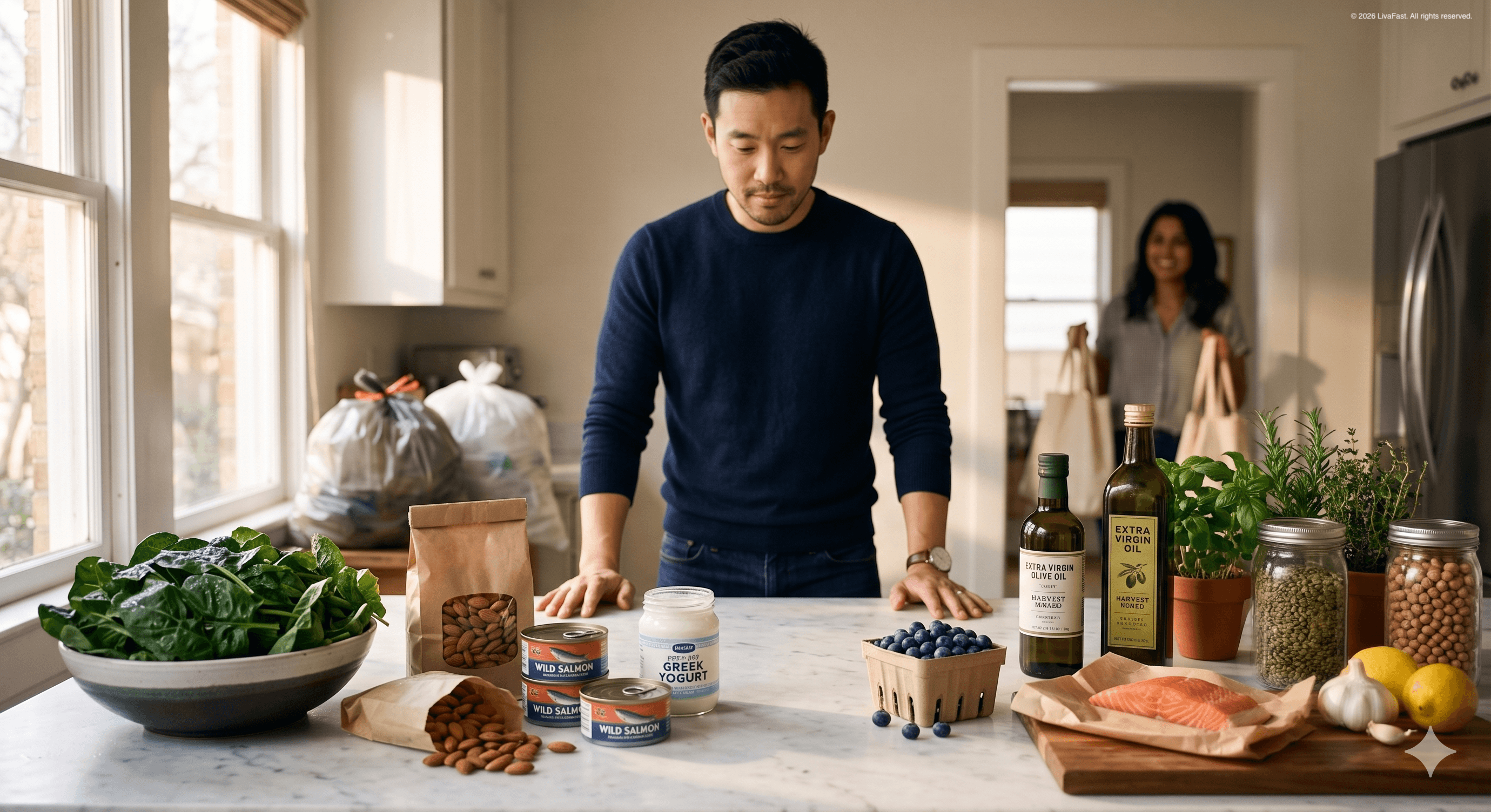
"That doesn't look like diet food," Mark said, surprised by his own fridge.
"Because it isn't," Priya said. "It's food that happens to heal your liver."
The shift happened while he was putting away the last container of blueberries.
For weeks — since the diagnosis, really — Mark had been thinking about his diet as a subtraction problem. What do I have to give up? A long list of things he enjoyed, surrendered to the altar of liver health, a penance he'd have to endure. Every dietary conversation had the structure of loss: stop eating this, eliminate that, avoid the other thing. The psychology of restriction. The architecture of misery.
But this — the counter full of food, the fridge stocked with more variety than it had ever contained, the embrace list longer than the avoid list — was addition. He wasn't narrowing his diet. He was expanding it. The processed food he'd been eating was actually the narrow thing — the same rotations of frozen pizza, takeout, energy drinks, ranch-dressing-on-everything. Repetitive. Unimaginative. A diet that felt abundant because of calories but was actually impoverished in every other dimension.
The Mediterranean-inflected embrace list was genuinely diverse. Fifteen types of vegetables. Eight kinds of protein. Multiple grains. Nuts, seeds, berries, herbs, olive oil. Textures and flavours he hadn't explored because he'd been too locked into convenience to bother.
And Dr. Nguyen's words from his last appointment landed with new weight: "Eighty percent adherence to a good pattern beats perfect adherence to something you can't sustain." She wasn't asking for purity. She was asking for a pattern — a way of eating that was sustainable enough to become his default, not an exercise in willpower he'd eventually abandon.
He could have the occasional pizza. The occasional energy drink. The goal was 80%, and 80% of this fridge was now stocked with foods that actively protected his liver. That was enough. That was the whole game.
That afternoon, Mark sat at the kitchen table and compiled the information he'd gathered over weeks of research into something concrete. Not theory. A reference he could tape to the fridge door.
He started with why each food on the embrace list mattered — not generically, not "it's healthy," but the specific mechanism by which it helped his liver.
The leafy greens were glutathione factories. Glutathione was the liver's master antioxidant — the molecule it manufactured to bind heavy metals, drugs, and toxic byproducts and shuttle them out of the body. When he ate spinach or kale, he was providing raw materials for that process. Chlorophyll supported Phase 2 detoxification — the methylation and conjugation pathways that inactivated toxins.
The fatty fish were omega-3 delivery systems. EPA and DHA did three specific things: they suppressed the transcription factors that triggered de novo lipogenesis, they increased beta-oxidation (the liver's fat-burning pathway), and they reduced hepatic triglycerides directly. A meta-analysis of nineteen studies had found that omega-3 supplementation alone reduced liver fat by 17–20%. Whole fish was even better because it delivered the omega-3s alongside vitamin D, selenium, and trace minerals.
The berries were anthocyanin concentrates. Anthocyanins — the water-soluble pigments that made berries blue, red, and purple — suppressed inflammatory markers (TNF-alpha, IL-6), reduced oxidative stress in hepatocytes, and improved the liver's antioxidant capacity. One study had given NAFLD patients just 200 grams of blueberries daily for eight weeks. Hepatic steatosis improved. No weight loss required.
The nuts and seeds were polyphenol packages — polyphenols, vitamin E, magnesium, fibre. Walnuts contained ALA, a precursor to EPA and DHA. A 2015 study had found that tree nut consumption was independently associated with lower liver fat, independent of weight loss.
The legumes worked through fibre and resistant starch. Soluble fibre fed beneficial gut bacteria, which produced short-chain fatty acids that repaired the intestinal barrier and suppressed liver inflammation. The resistant starch reduced hepatic DNL and improved insulin sensitivity.
Then he wrote the avoid list — shorter, but each item with a specific mechanism of harm.
The energy drinks: fifty-four grams of sugar, most of it fructose. Fructose was metabolized almost exclusively in the liver — unlike glucose, which every cell could use. Fructose entered liver cells and was immediately converted to acetyl-CoA, then re-esterified into triglycerides. One can of sugary soda could measurably increase hepatic triglycerides. It wasn't about the calories. It was about which organ had to process them.
The ranch dressing: soybean oil — high in omega-6 polyunsaturated fats, which were pro-inflammatory when consumed in excess. The omega-6 to omega-3 ratio mattered, and soybean oil pushed it in the wrong direction.
The frozen pizza: refined carbohydrates that spiked blood glucose without fibre to moderate absorption. His pancreas responded with a massive insulin surge. His liver saw the insulin signal and activated lipogenic enzymes. This was the vicious cycle he'd mapped in chapter 10, playing out at every meal.
The ultra-processed foods were the worst category — not just for their macronutrient profile, but for what they contained beyond the calories. Emulsifiers like polysorbate-80 directly damaged the intestinal barrier, triggering endotoxemia. Additives consumed glutathione and antioxidant capacity. Trans fats accumulated in cell membranes and caused inflammation and hepatocyte dysfunction.
Mark printed the two lists and taped them to the inside of a kitchen cabinet — visible every time he opened it, invisible to guests. A private reference. A map of what his liver needed and what attacked it.
That evening, he and Priya cooked together — canned salmon tossed with dark greens, olive oil, lemon, and white beans. Twenty minutes. Biscuit supervised from his station near the stove, alert for anything that might hit the floor.
"This is more food than we used to eat," Priya observed, looking at the plates.
She was right. The portions were generous. The plate was full of colour and texture — things the frozen-pizza-and-ranch-dressing era had never offered. Mark ate until he was satisfied, not stuffed, and set his fork down without the familiar urge to keep going.
"Dr. Nguyen was right," he said. "Eighty percent of a good pattern. That's sustainable. I can do this for the rest of my life."
"That's the point," Priya said. "This isn't a twelve-week diet. It's how we eat now."
Fatty liver disease affects 38% of adults globally. Learn what MASLD is, why the name changed from NAFLD, and what you can do about it.
Track this in LivaFast
Your FIB-4 score updates automatically from your labs.