Chapter 11 · The Mediterranean Bet
The diet that heals your liver without feeling like a diet
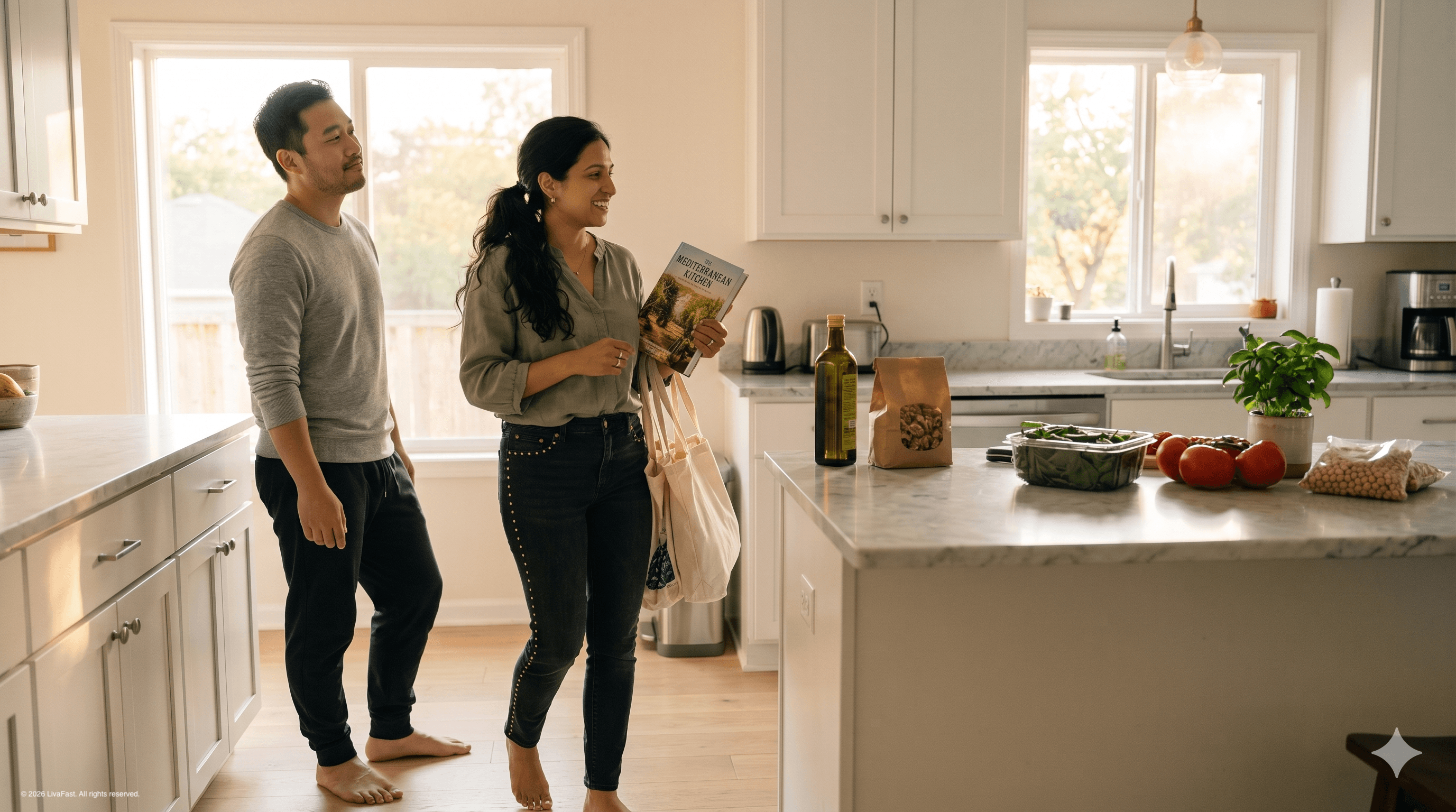
Priya walked through the door on a Thursday evening with an armload of cloth grocery bags and a smile that Mark recognized immediately — the one that meant she'd made a decision and was presenting it as a discussion purely out of courtesy.
Before he could ask about her day, she set a hardcover cookbook on the kitchen counter — The Mediterranean Kitchen — and tapped it with one perfectly manicured finger.
"We're doing this," she announced.
Mark looked at the cover. Sun-drenched olive groves. A platter of grilled fish. Salads that spilled off the edges of ceramic bowls in colours he associated with Italian paintings, not weeknight dinners. His stomach, which had been quietly nursing a grudge about the uninspired desk lunch he'd eaten six hours earlier, made a sound like a ship settling in harbour.
"I can't eat like a Greek fisherman," he said, but he was already looking at the grilled salmon photograph on page 47, and his resolve was doing things it shouldn't do.
"You're not eating like a Greek fisherman." Priya was unpacking the bags with the efficiency of someone who had rehearsed this moment in the car. "You're eating like Mark Chen who wants his liver to stop accumulating fat." She pulled out a glass bottle of olive oil — actual extra virgin, heavy in the hand, the label in Italian — and set it next to the cookbook. "Besides, have you tasted Mediterranean food? It's not punishment. It's the opposite of punishment."
Mark picked up the cookbook and opened it at random. Page 93: warm roasted salmon with lemon, fennel, and herbs. Fresh dill. A squeeze of lemon over everything. The kind of food that looked like it belonged on a restaurant table, not in a therapeutic diet plan.
"This actually looks good," he said.
"Of course it looks good. Mediterranean diet isn't some austere health-nut regime. It's how people in actual Mediterranean countries have been eating for centuries because they enjoy it." She was still unpacking — fresh herbs in a ceramic pot for the windowsill, a paper bag of walnuts, tomatoes so red they looked like they'd been engineered by someone who understood longing. "Dr. Nguyen told me at our last call that this is the single best dietary pattern for your liver. She said the evidence is overwhelming."
Mark set the cookbook down carefully. "She said that?"
"She said, and I quote: The Mediterranean dietary pattern is the primary recommendation for MASLD management. Primary. Not optional. Not one-of-several. Primary."
"Even if I don't lose weight?"
"Even then. The diet works at the level of liver metabolism itself, not just through weight loss." Priya had clearly done her own research. She pulled out a bag of dried chickpeas and held them up like evidence in a court case. "The clinical trials showed a 39% reduction in hepatic steatosis in one year. On a diet that includes pasta and olive oil. Tell me that's punishment."
Mark looked at the chickpeas, the olive oil, the tomatoes, the herbs. He looked at Priya, who had spent her evening driving to three different stores to assemble the ingredients for a dietary intervention she'd researched on her own time, because she loved him and because love, in the Chen household, had always been expressed through logistics.
"Okay," he said. "Let's make the lemon pasta."
By 8 PM, Mark was sitting at the kitchen table with a plate of spaghetti that had taken twenty minutes. Olive oil, lemon, fresh basil, garlic, a handful of toasted pine nuts. Nothing else. Biscuit was stationed at his feet, locked onto the trajectory of each forkful with the intensity of a missile guidance system. The pasta was warm and bright and somehow tasted like more than the sum of its ingredients.
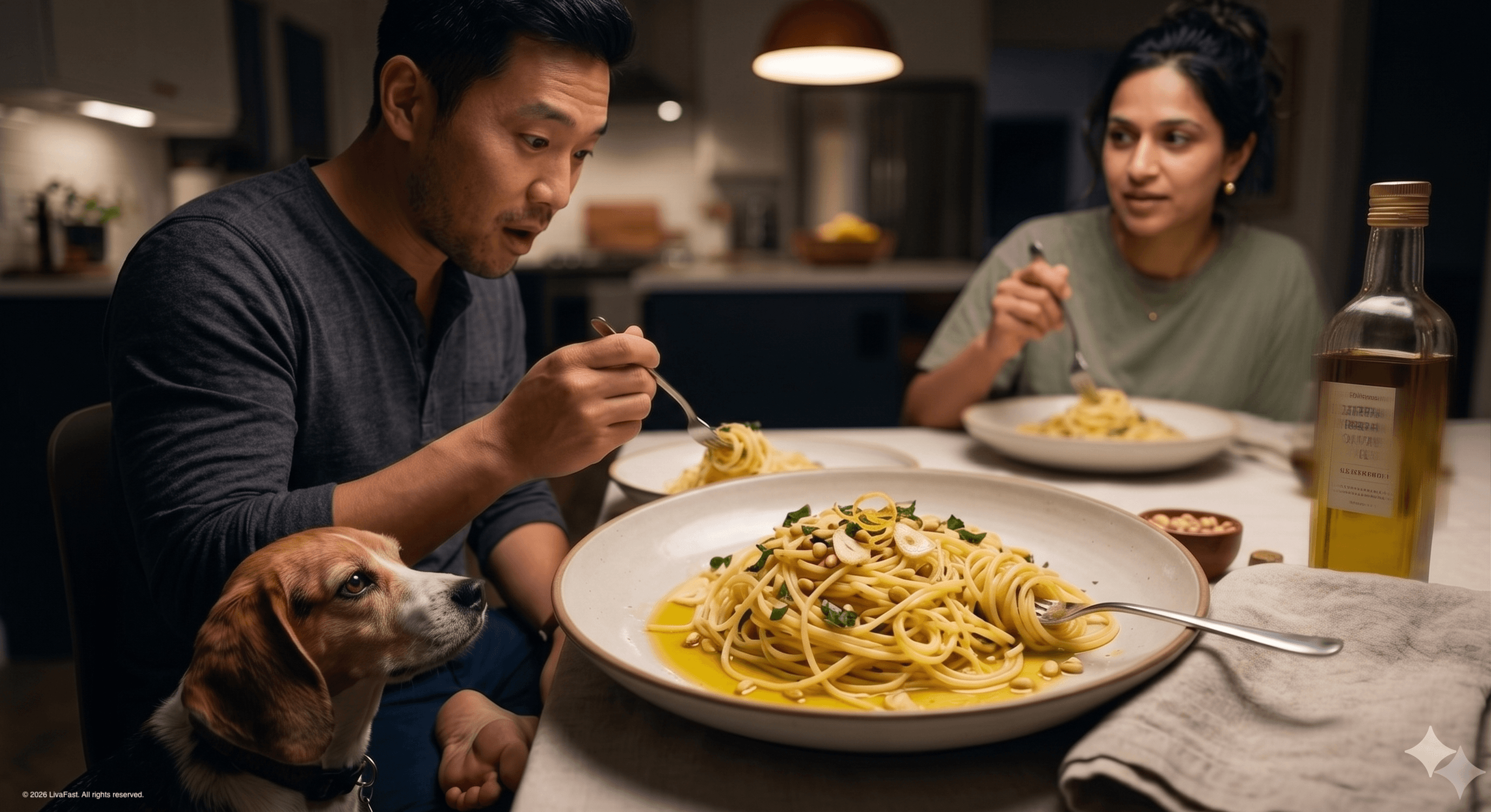
"This is actually good," Mark said.
"I know," Priya replied, twirling her own fork. "Welcome to the part where taking care of yourself isn't miserable."
The next morning, Mark sat at his desk with his coffee and opened the paper Dr. Nguyen had referenced — a 2023 consensus statement from the European Association for the Study of the Liver, the European Association for the Study of Diabetes, and the European Association for the Study of Obesity. Three major medical organizations. All saying the same thing:
"The Mediterranean dietary pattern is the primary dietary recommendation for the management of MASLD."
Not "consider." Not "might help." Not "one option among many." Primary recommendation.
He read it three times.
Then he pulled up the clinical evidence. A 2021 randomized controlled trial — 259 MASLD patients, one year. One group ate Mediterranean. The other ate low-fat, the old recommendation. The Mediterranean group saw a 39% reduction in hepatic steatosis, measured by both ultrasound and MRI-PDFF.
But the finding that stopped him was buried a paragraph deeper: the improvement happened even in patients who didn't lose weight. The diet was working at the level of liver biochemistry, not just through caloric deficit or body composition changes. Something about the specific foods — the olive oil, the fish, the vegetables, the legumes — was directly altering how the liver processed and stored fat.
Another trial, the MEDALIST study, compared Mediterranean against low-carb and low-fat approaches over twenty-four weeks. Mediterranean achieved the best combination across all three endpoints: liver fat reduction, liver inflammation reduction, and metabolic marker improvement. Not the best at one thing. The best at everything.
Mark sat back in his chair and thought about the lemon pasta from last night. The olive oil glistening on the noodles. The basil. The garlic. He thought about how, for weeks, he'd been operating under the assumption that healing his liver meant restriction — counting, measuring, denying. The fasting protocol was structured denial, even if it had become sustainable. The calorie awareness was constant background noise. Every meal carried a faint charge of anxiety: Is this helping or hurting?
But the Mediterranean evidence was saying something different. It was saying: Eat more of these specific foods, and your liver gets better. Not less food. More of the right food. Abundance as intervention. That was a framework he could sustain for a lifetime, not twelve weeks.
He texted Dave: "Did you know the Mediterranean diet reduces liver fat even without weight loss?"
"Yeah, the polyphenols in olive oil are genuinely medicinal. Oleocanthal is basically an anti-inflammatory drug that happens to taste like olive oil."
"Why does nobody talk about this?"
"Because 'eat olive oil and fish' doesn't sell supplements."
That evening, Priya made the salmon from page 47. Lemon, fennel, fresh dill, roasted at high heat until the skin was crisp and the flesh was pink and flaking. A side of roasted broccoli with olive oil and garlic. Brown rice.
Mark ate slowly. Not because he was being mindful — he'd never been good at the mindful eating thing — but because it was genuinely good and he wanted it to last. Biscuit positioned himself precisely between both chairs, hedging his bets.
"I think this is the thing I was missing," Mark said, halfway through the salmon.
Priya looked up. "Which thing?"
"The food part. I had the fasting figured out. The timing. The insulin stuff. But I was eating whatever during my eating window — chicken and rice, mostly. Functional food. Fuel. I wasn't thinking about what the food was doing to my liver biochemistry."
"And now?"
"Now I understand that it's not just about when I eat. It's about what I eat during that window. The olive oil, the omega-3s, the polyphenols — they're not just calories. They're actively suppressing DNL and reducing inflammation and repairing mitochondria. The fasting gives my liver a break from insulin. The food gives it the materials to heal."
Priya smiled. "See? That's the part I was trying to tell you. The fasting is the structure. The food is the medicine."
She was right. The fasting protocol created the hormonal environment for recovery — low insulin, lipid mobilization, metabolic reset. But the Mediterranean diet provided the biochemical tools for the liver to actually do the healing. Without the right inputs during the eating window, the fasting was only half the intervention.
Together, they were the full protocol.
That night, Mark opened his notes app and added a new section to his "What's Happening in My Body" document: Food as pharmacology. He listed the key compounds and what they did:
Oleocanthal (olive oil): anti-inflammatory, suppresses COX enzymes Omega-3 EPA/DHA (fatty fish): reduces hepatic triglyceride synthesis, increases beta-oxidation Polyphenols (olive oil, berries, nuts): protect mitochondrial function in hepatocytes Fibre (legumes, whole grains): feeds beneficial gut bacteria, maintains intestinal barrier Anthocyanins (berries): antioxidant, reduces oxidative stress in liver tissue Lycopene (tomatoes): hepatoprotective, reduces stellate cell activation
He looked at the list. Six categories of compounds, each doing something specific and measurable inside his liver. Not vague "healthy eating." Targeted biochemistry delivered through food that happened to be delicious.
He closed the laptop and carried the dishes to the sink. Priya was on the couch with her book. Biscuit had given up on scraps and was asleep in his corner.
The kitchen smelled like roasted salmon and lemon. It smelled like the opposite of deprivation.
Fatty liver disease affects 38% of adults globally. Learn what MASLD is, why the name changed from NAFLD, and what you can do about it.
Track this in LivaFast
Your FIB-4 score updates automatically from your labs.