Chapter 2 · The Four Floors
Understanding the stages of liver disease
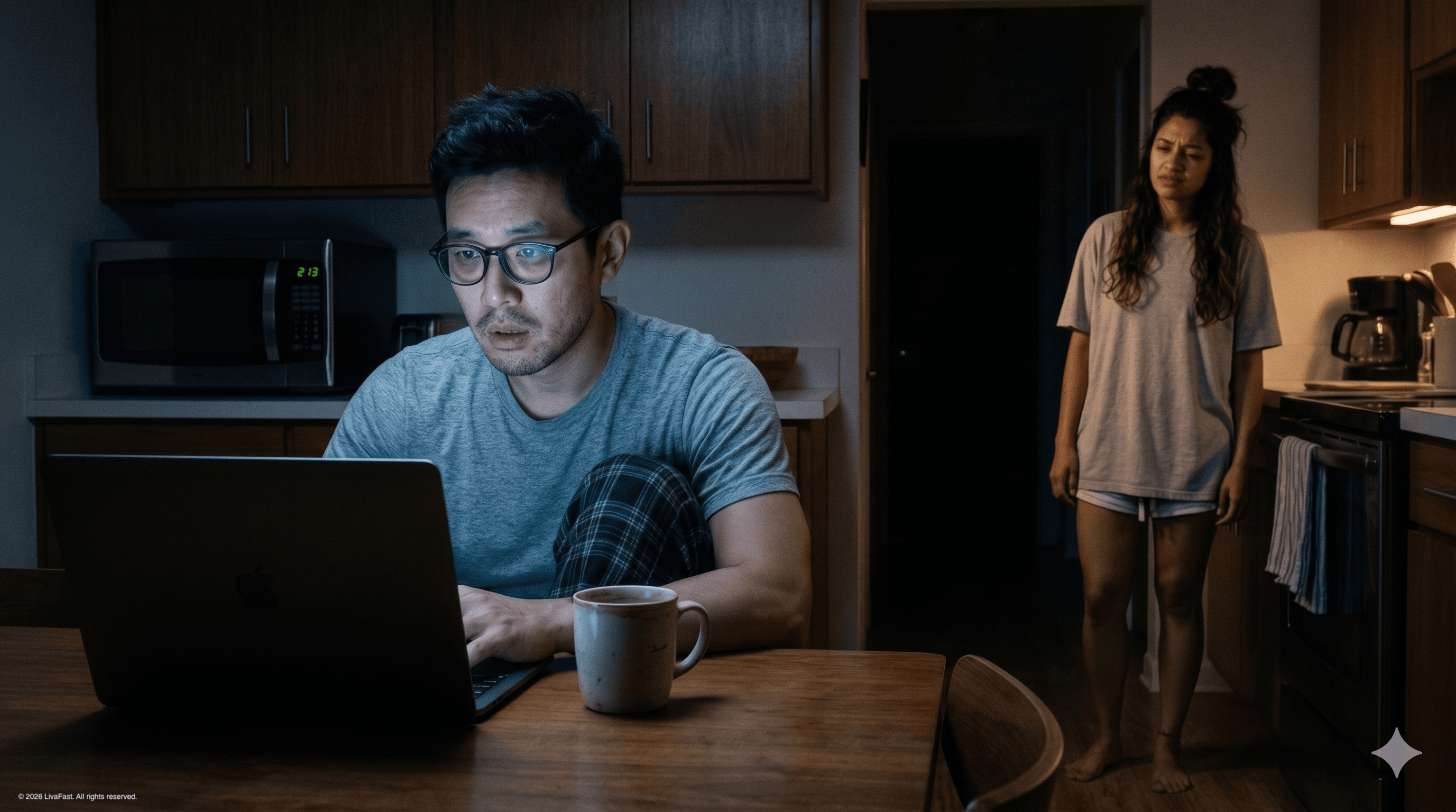
It was 2:13 AM, and Mark hadn't slept. He sat at the kitchen table with his laptop glowing in the dark, a cup of cold coffee growing skin beside his keyboard, and an open tab that read "Liver Cirrhosis: End-Stage Disease and Prognosis."
He'd started with a reasonable Google search — "NAFLD progression timeline." Reasonable. Safe. Educational. That search had led to another, which led to another, until he was four levels deep in medical abstracts and forum posts from people whose livers had failed. People who talked about transplant lists and ascites and portal hypertension like these were things that happened to real human beings, not imaginary worst-case scenarios Mark was constructing in real time at his kitchen table.
One forum post stood out. A man, maybe fifty, writing with the flat affect of someone who'd been through it: "I was diagnosed with simple steatosis. Thought I had time. Didn't make changes. Five years later, I was in Stage 4 cirrhosis. Don't be like me."
Mark stared at the screen. Five years. He'd been diagnosed five days ago.
The kitchen door creaked open. Priya emerged from the hallway in her old UT sweatshirt, squinting at him like he was a ghost.
"Mark, what are you doing?"
"I'm researching," he said, which sounded better than I'm catastrophizing about my impending liver failure at two in the morning while our children sleep ten feet away.
Priya walked over and looked at the screen. He watched her read the tab title. Her expression shifted — not to judgment, but to something softer. She pulled out the chair across from him and sat down.
"Okay," she said. "Tell me what's happening."
"My liver is dying," Mark said flatly.
"Is it?"
"It's going to. The doctor said so. NAFLD progresses. People end up needing transplants. This guy on the forum was diagnosed with simple steatosis, same as me, and five years later —"
"Did your doctor say your liver was dying?"
Mark thought back to Dr. Kim's office. She'd said it was manageable. She'd said early intervention worked. But she hadn't said he'd be fine. She hadn't promised him anything. No doctor ever promises you anything.
"No," he admitted. "But she didn't promise I'd be okay either."
Priya reached across the table and closed the laptop. The sudden darkness felt like a judgment of its own. "Here's what I know," she said. "It's 2 AM. Your brain has been marinating in worst-case scenarios for four hours. You're catastrophizing. That's not diagnosis — that's insomnia talking." She paused. "Drink some water. Come to bed. We'll look at this with fresh eyes tomorrow."
But Mark didn't want to come to bed. He wanted to understand the map of the disease — the stages, the exit ramps, the places where reversal was still possible and the places where it wasn't. He wanted to know exactly how much time he had before things got bad. Before the building started to collapse.
"Just let me read one more thing," he said.
Priya sighed, but she stayed. She pulled the laptop back open and typed her own search: "NAFLD reversible stages."
This time, the results were different. Studies showing that fibrosis could reverse. Articles about how early intervention changed outcomes. Data showing that patients at Mark's stage — simple steatosis, no significant inflammation — had the highest likelihood of complete reversal with lifestyle changes alone.
One headline caught both their eyes: "7 of 10 Patients with Stage 3 Fibrosis Showed Complete Reversal in Two-Year Study."
"That's serious fibrosis," Priya said quietly. "And seven of them got better."
She was right. Mark felt something shift inside him — not relief, exactly, but a narrowing of the catastrophe into something manageable. The disease had stages. His was the first. And reversal wasn't theoretical. It was documented.
"We're going to figure this out," Priya said. She squeezed his hand. "But not at 2 AM."
They went to bed. Mark slept, finally, and when he woke up the light was coming through the kitchen window and the coffee Priya had made was hot and fresh. He sat down at his laptop again, but this time with different energy. Not panic. Purpose.

He found a line in a hepatology textbook that made everything click: "The liver's remarkable regenerative capacity means that early-stage disease is highly reversible. Intervention at Stage 1 offers the best outcomes, with lifestyle modification alone potentially achieving complete resolution."
Reversible. Not in five years. Not maybe. Reversible — if he acted now, while the building still had all four floors intact.
That afternoon, Mark downloaded an app that let him log his diagnosis stage and enter lab values — ALT, AST, GGT — and watch them as a trend line over time. He plugged in his numbers: ALT 78, AST 52. The app marked him as "Low Risk" on a gradient that extended into dangerous territory. But the visual was clear: there was room to move, and the direction of movement was up to him.
He added a note in the app: "Starting 12:12 intermittent fasting. Follow-up labs in 8 weeks."
It wasn't a plan yet — not really. It was a sentence. But it was the first sentence he'd written that pointed forward instead of down.
Understand the four stages of fatty liver disease — from simple steatosis to cirrhosis — and what you can do at each stage to slow or reverse progression.
Track this in LivaFast
Your FIB-4 score updates automatically from your labs.