Chapter 22 · The Day I Almost Quit
Why the psychological burden of MASLD is real — and why self-compassion is medicine

Mark is sitting in his car in the company parking lot, and he can't stop crying.
It's 2:47 PM on a Wednesday. He's supposed to be back in the office in two minutes for a product sync meeting. His eyes are red and swollen. His chest is heaving in that ugly, gulping rhythm that makes it impossible to compose a face anyone would believe. There's no cold water trick, no deep breath, no quick fix that will make him look like a functional VP who has his life together.
He calls the meeting organiser and lies: "Something came up. Won't make it."
Then he sits in the driver's seat of his Civic, hands gripping the steering wheel at ten and two, and lets the weight of the past nine weeks crash down on him like a wave he's been outrunning since the diagnosis.
The constant mental load of meal planning. Every grocery trip an exercise in label-reading and sugar-counting and weighing whether this yogurt or that sauce is going to cost him progress he can't measure until his next lab draw. The social isolation — he'd skipped Dave's happy hour last Friday, sat home eating grilled chicken and roasted broccoli while his friends had IPAs and talked about things that didn't involve hepatic steatosis. The anxiety that had moved into his chest and refused to leave, paying no rent, contributing nothing, just sitting there like a stone he'd swallowed.
And the slip-up. Sarah's birthday dinner on Sunday. Three slices of cake. A margarita. Bread with actual butter. He'd eaten it all with a desperation that felt less like enjoyment and more like a hostage breaking free — and then he'd spent the next two days in a guilt spiral that felt indistinguishable from shame. Every bite replayed. Every gram of sugar calculated retrospectively. The internal voice — the one that had been getting louder for weeks — saying: You've ruined it. Four days of progress, gone. You're not disciplined enough for this.
And underneath it all, the question that had been building pressure since Dr. Nguyen said the words "long-term maintenance" at his last appointment:
Can I do this for the rest of my life?
Because that's what she'd said, in the gentlest possible way. "These lifestyle changes aren't a twelve-week fix, Mark. You'll need to maintain them long-term." Long-term. Forever. No finish line. No graduation. No moment where he could stop being vigilant and just eat a piece of cake without the voice.
He pulled out his phone and texted Priya: "I don't think I can do this."
He stared at the words for thirty seconds, then added: "Not for the rest of my life. It's too much."
The response came three minutes later: "Call me."
He did. And when he heard her voice, he cried harder.
"I'm sorry," Priya said immediately. "I know this is hard. I know it feels impossible right now."
"It IS impossible," Mark said. His voice was broken and raw and he didn't care. "I can't plan every meal forever. I can't skip dinners with my friends forever. I can't be anxious every time someone hands me a drink or puts cake in front of me. This isn't a life. It's a sentence."
Priya was quiet for a moment. The kind of quiet that wasn't absence but presence — the silence of someone choosing their words because the words mattered.
"Okay," she said. "Here's what I'm thinking. You don't have to do this forever right now. You just have to do it until your next labs. That's in three weeks. Can you do three weeks?"
"Three weeks feels —"
"Then just today. Can you not eat cake today?"
Mark laughed despite himself. The laugh was really just crying with a different shape, but it broke something loose in his chest — some locked-up thing that had been compressing for days.
"I already ate cake," he said.
"Okay. Tomorrow. Can you not eat cake tomorrow?"
"Yeah," Mark said. "I can probably not eat cake tomorrow."
"Then that's all you have to do. Tomorrow. One day. And then the day after that, you do it again. And if you slip, you slip, and you do the next day. That's it."
It took Mark until Thursday morning to fully absorb what had happened in his car. The crying wasn't weakness. It wasn't failure. It was the accumulated weight of nine weeks of chronic disease management — the vigilance, the restriction, the social cost, the uncertainty, the guilt — finally exceeding his capacity to carry it silently.
And by Friday, sitting at the kitchen table before his morning walk, he found research that made him cry again. But differently.

The prevalence of anxiety in MASLD patients was 37.2 percent. More than one in three. He wasn't broken. He wasn't uniquely fragile. He was experiencing a documented, measurable psychological response to living with a chronic, invisible disease that required permanent lifestyle modification and offered no visible external symptoms to validate the effort.
Then he read something that stopped him cold.
Patients who were harsh with themselves about their disease — who treated every dietary slip as a moral failure, who spiralled into shame after a piece of cake, who beat themselves up for imperfection — showed worse outcomes. Less behaviour change. More depression. Higher treatment abandonment.
But patients who practised self-compassion — who said "I messed up today, and I'll get back on track tomorrow" instead of spiralling — had better adherence, more consistent lifestyle changes, lower anxiety, and faster recovery from setbacks.
Cruelty didn't work. Kindness did.
And it wasn't a soft, feel-good finding. It was measurable. The mechanism was clear: when you slipped and responded with self-compassion, your nervous system stayed regulated. You could return to the behaviour the next day. When you slipped and responded with self-criticism — I'm such an idiot, I ruined everything, I might as well give up — your nervous system entered threat mode. Shame triggered the "why bother?" response. And the "why bother?" response led to either punishing restriction (the crash-diet trap) or total abandonment.
The internal voice that had been telling Mark he'd ruined everything with three slices of cake wasn't motivating him. It was destroying him. And the research said so, in clear, replicated, peer-reviewed language.
He opened his notes app and typed:
"Self-compassion is not weakness. Self-compassion is evidence-based medicine."
"Three slices of cake didn't undo nine weeks of progress. The shame about the cake almost did."
That evening, Mark told Priya about what he'd read. They sat at the kitchen table — the table that had become the site of every revelation, every spreadsheet, every breathing exercise, every late-night research session.
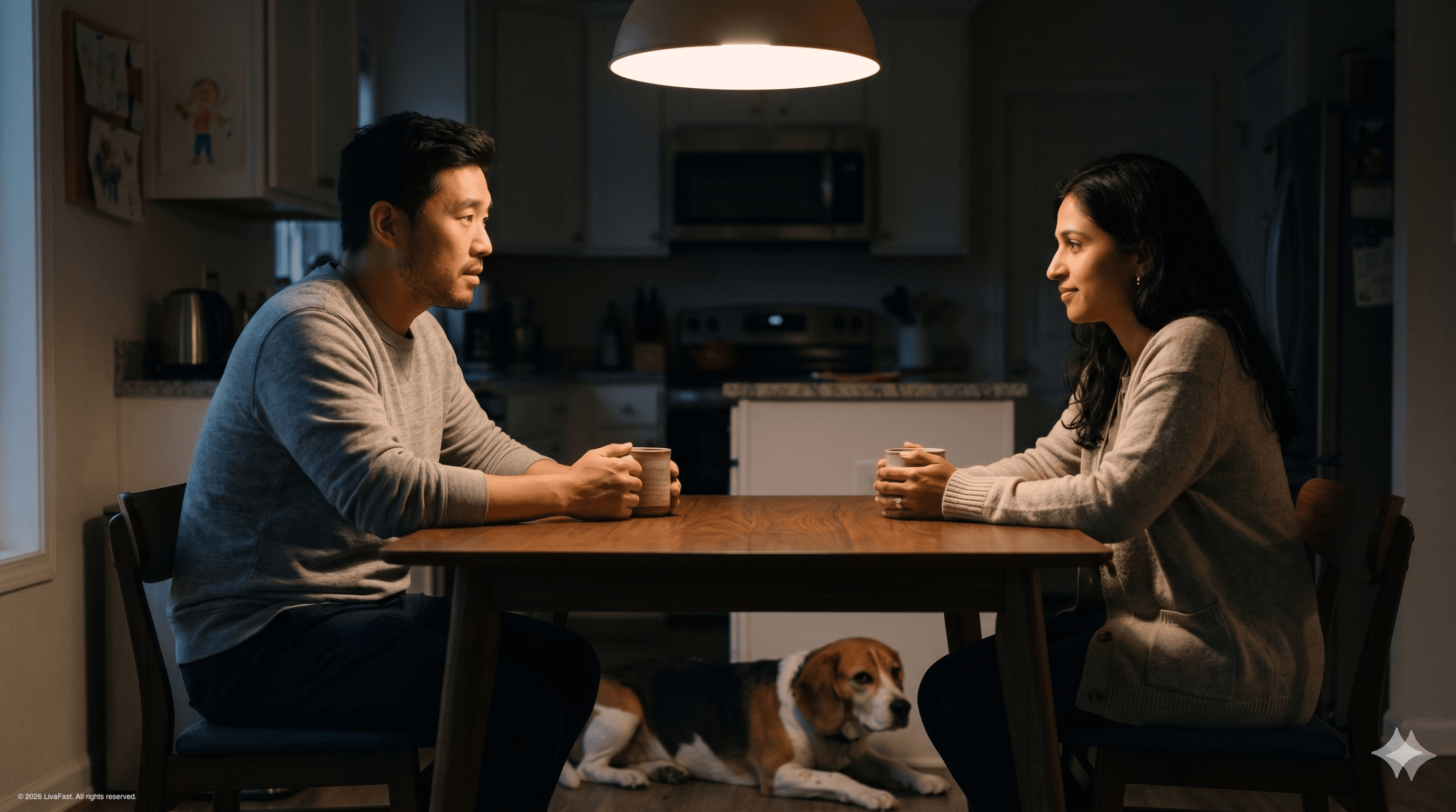
"37 percent of MASLD patients have clinically significant anxiety," he said. "That's not a small number. That's more than one in three."
"And you're surprised you're one of them?" Priya said gently.
"I thought I was handling it. I thought the fasting and the walking and the tracking meant I had it under control."
"You had the liver part under control. The mind part — the part that wakes you at 3 AM and makes you cry in parking lots — that's a different system. And it needs its own intervention."
She was right. He'd built a five-pillar protocol — fasting, diet, exercise, sleep, stress management — and ignored the sixth: his relationship with the diagnosis itself. The grief. The fear. The exhaustion of permanent vigilance. The loneliness of managing an invisible disease in a world that couldn't see it.
"I think I need to talk to someone," Mark said. "Not you — you've been incredible. But a professional. Someone who does this."
"CBT?" Priya asked.
"Maybe. Or ACT — acceptance and commitment therapy. There's research showing it reduces the struggle against the diagnosis. Helps you stop fighting the fact of being sick and start building a life around it."
"That sounds right," Priya said. "You don't need more discipline. You need more compassion."
Mark looked at Biscuit, who had positioned himself between their chairs with the precision of a therapist arranging a consultation room.
"I'm going to find a therapist," Mark said. "And I'm going to stop pretending that three slices of cake at a birthday dinner undid nine weeks of metabolic improvement."
"Three slices of cake at a birthday dinner is called being human," Priya said.
"Yeah," Mark said. "I'm starting to understand that."
The next morning, Mark opened his tracking app. His streak showed a gap — the days after Sarah's dinner, when he'd been too ashamed to log anything. He'd treated the gap as evidence of failure. Now he looked at it differently. The gap was two days out of sixty-three. Ninety-seven percent compliance. The trend lines — ALT declining, weight declining, waist circumference declining — were unaffected by two days of birthday cake.
The cake hadn't moved the needle. The shame had almost made him quit.
He logged his data for the day. Fasting hours: 16. Sleep: 7.4. Steps: 9,200. Energy: 6. Stress: 5. And in the notes field, he typed something new:
"Had a bad week. Cried in my car. Read about self-compassion. Came back. Still here."
He closed the app and went to walk Biscuit.
Fatty liver disease affects 38% of adults globally. Learn what MASLD is, why the name changed from NAFLD, and what you can do about it.
Track this in LivaFast
Your FIB-4 score updates automatically from your labs.