Chapter 14 · The One Good Vice
Why your morning coffee might be saving your liver
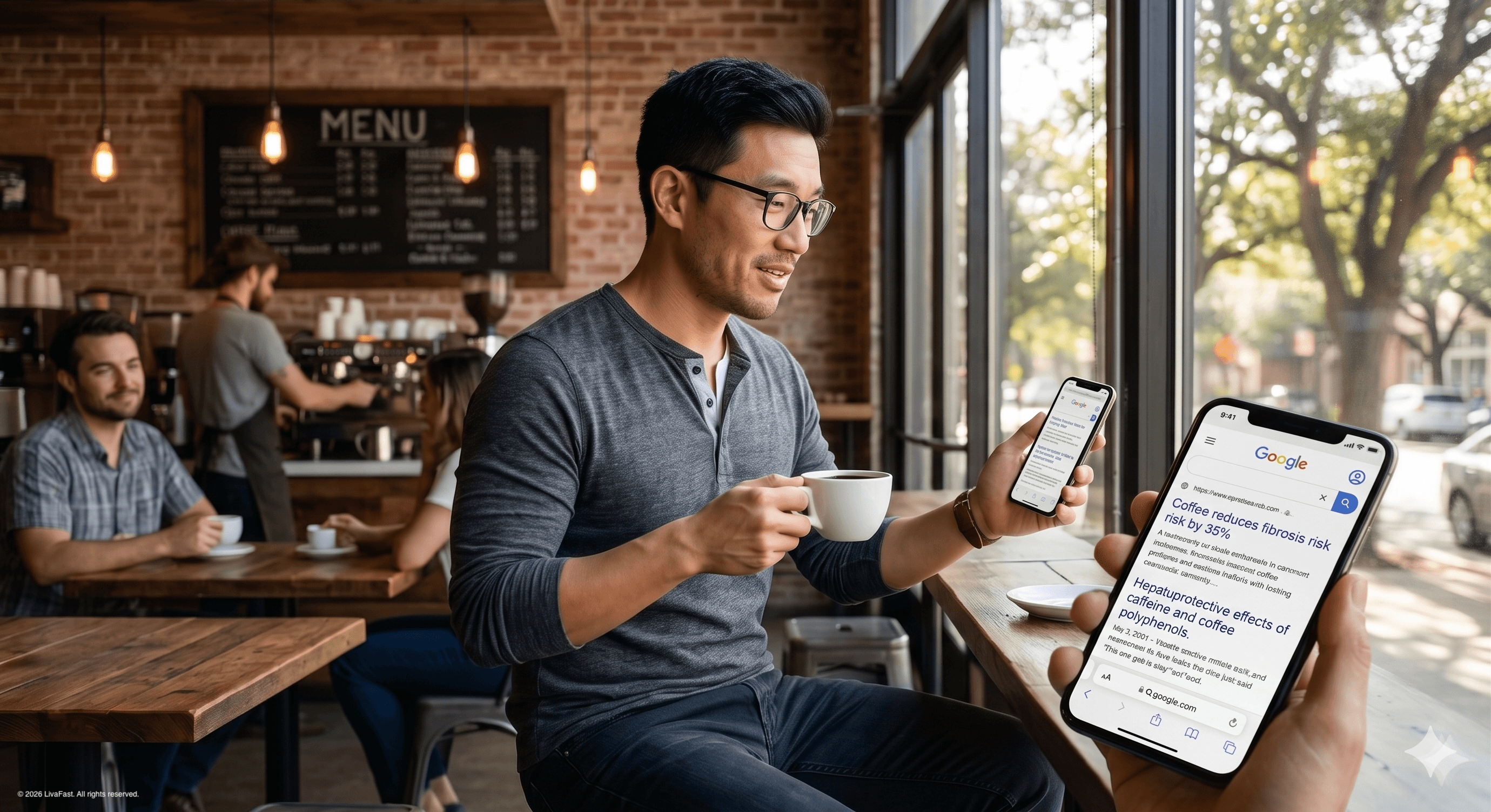
Mark was sitting in a café on Congress Avenue — one of those Austin places with reclaimed wood tables and a barista who remembered his order and a sound system playing something acoustic and vaguely optimistic — when he realized he was terrified of his own coffee.
He held the cup like it might detonate. Black americano, double shot, the way he'd been drinking it for five years. It was the last thing standing. The energy drinks were gone. The orange juice was gone. The sweetened yogurt, the granola bars, the ranch dressing, the frozen pizza — all purged, all replaced, all filed under "things that were quietly destroying my liver while I thought they were harmless."
Coffee was next. It had to be. Ever since the diagnosis, since the fridge purge and the sugar audit and the weeks of learning that everything he'd assumed was fine was actually metabolically catastrophic, Mark had been waiting for the other shoe to drop. For Dr. Nguyen or Priya or some paper on PubMed to tell him that his one remaining morning ritual — the thing that made 6 AM a negotiable proposition instead of an existential crisis — was also poisoning his liver.
He pulled out his phone, took a breath, and typed: "Is coffee bad for fatty liver?"
The results loaded. And then something happened that Mark had not expected at any point during the past eight weeks of his 12-week reset.
The first result said: "Coffee reduces fibrosis risk by 35%."
He read it three times. Then he kept scrolling.
"Regular coffee consumption associated with lower cirrhosis odds."
"Hepatoprotective effects of caffeine and coffee polyphenols."
"Meta-analysis: each cup of coffee daily associated with 12% reduction in liver disease mortality."
Mark lowered the cup. Took a sip. The coffee was hot and bitter and tasted, for the first time in weeks, like something that wasn't going to hurt him. Like something that was, impossibly, on his side.
"This one gets to stay," he said aloud, to the cup, to the café, to no one. A woman at the next table glanced over and smiled like she understood.
He spent the next hour in that café reading through the literature on his phone, his americano getting cold beside him because he kept forgetting to drink it. The data was consistent in a way that medical research rarely was — study after study, the same finding, across different populations and methodologies and decades of evidence.
Coffee wasn't just neutral for liver health. It was actively protective.
A meta-analysis of sixteen prospective studies — over 432,000 participants — found that each daily cup of coffee was associated with a 12% reduction in mortality from liver disease. Three cups a day corresponded to a 39% reduction in cirrhosis risk. And the effect wasn't confined to healthy people. It showed up in MASLD patients specifically, across all subgroups: different ages, different BMIs, different disease severities.
Most of his interventions came with qualifiers. The fasting worked if he was consistent. The Mediterranean diet worked if he maintained the pattern. The sugar reduction worked if he stayed under 25 grams. Coffee was different. Coffee just worked. Regardless. Across the board. Like some quiet ally that had been sitting on his countertop every morning, doing its job without asking for credit.
He texted Priya: "Coffee is literally medicine. I'm keeping it."
"You say that like I was going to take it from you."
"I was scared you were."
"Mark, I would never. Some things are sacred."
He smiled and took another sip — this one warm, deliberate, grateful.
That evening, Mark sat at the kitchen table with his laptop and read the mechanistic research. He wanted to understand why — not just that coffee was protective, but what it was actually doing inside his liver cells.
The answer was more complex than he expected. Coffee wasn't just caffeine. That was the misconception that had led the medical world to dismiss it as a stimulant for decades. A single coffee bean contained over a thousand bioactive compounds. The three that mattered most for his liver were working through completely different pathways.
Caffeine was the one everyone knew — 80 to 100 milligrams per cup. It had modest hepatoprotective effects on its own, but it wasn't the main driver.
Chlorogenic acid was the one nobody talked about — 200 to 550 milligrams per cup, depending on roast and brewing method. A polyphenol that acted as both antioxidant and anti-inflammatory agent. It suppressed TNF-alpha, the inflammatory cytokine that drove the progression from simple steatosis to MASH. It crossed the mitochondrial membrane and scavenged reactive oxygen species before they could damage the energy-producing machinery of his liver cells.
And then there were the broader polyphenols — caffeic acid, ferulic acid, and dozens of others — that worked synergistically. Together, they accomplished something no single compound could achieve alone, which was why coffee consistently outperformed caffeine supplements and green tea extracts in clinical studies. The whole was genuinely greater than the sum of its parts.
Mark traced the four mechanisms through his notes:
Fibrosis prevention. The polyphenols modulated hepatic stellate cells — the cells responsible for laying down scar tissue when activated by inflammatory signals. Coffee polyphenols kept them calm. A 2016 study in Hepatology analyzing 7,644 participants found that regular coffee drinkers had across-the-board fibrosis reduction. For those at highest risk, coffee reduced advanced fibrosis odds by 35%.
Mitochondrial protection. His hepatocytes' mitochondria were damaged by MASLD — they produced excessive reactive oxygen species, which perpetuated the inflammatory cycle. Chlorogenic acid crossed the mitochondrial membrane and neutralised ROS before it could cause further damage. One of the few interventions that actually repaired the liver's energy-producing capability.
Fat accumulation reduction. In animal models, coffee polyphenols directly suppressed the genes involved in de novo lipogenesis and fatty acid uptake. The liver made less new fat and absorbed less circulating fat. This happened partly through improved insulin sensitivity and partly through direct hepatic gene expression changes.
Microbiome support. Most coffee polyphenols were unabsorbed in the small intestine, reaching the colon intact where they fed beneficial bacteria. Short-chain fatty acid production increased. Intestinal barrier integrity improved. Bacterial endotoxin translocation decreased. Less leaky gut meant less LPS in the bloodstream meant less liver inflammation.
Four mechanisms. One cup of coffee. Working on fibrosis, mitochondria, fat accumulation, and the gut simultaneously.
Mark looked at his empty americano cup sitting on the table and felt something he hadn't felt about food or drink in weeks: uncomplicated pleasure. Everything else in his dietary overhaul had come with an asterisk — good, but only if you do it this way, only in this amount, only at this time. Coffee was the rare intervention that was both protective and enjoyable. Medicine that tasted like a morning ritual.
He texted Dave: "My doctor says coffee is medicine. Finally, a recommendation I can get behind."
Dave replied in seconds: "I told you that five years ago. Now you believe hepatologists instead of your best friend?"
Fair point.
The next morning, Mark adjusted his coffee routine with the same intentionality he'd brought to his fasting protocol. He'd learned that the dose-response relationship had a sweet spot — two to three cups daily was where the fibrosis reduction and ALT improvement evidence clustered. More than four cups didn't add further benefit and could interfere with sleep, which was its own liver-recovery variable.
His double americano at 6:30 AM was roughly two cups worth. Perfect. A second cup at 10 AM if the morning called for it. Nothing after 2 PM — that was the hard rule. Caffeine had a half-life of five to six hours, and sleep quality mattered more than polyphenol intake.
He'd also learned that brewing method changed the equation. French press and cold brew extracted the most chlorogenic acid — over 200 milligrams per cup — because the paper filter in drip machines removed some compounds. Espresso delivered less per shot due to short contact time and small volume, which meant his americano needed the double shot to reach therapeutic territory.
And what you added mattered. Black coffee delivered all the benefits intact. Sugar immediately undermined the antioxidant and anti-inflammatory effects — a flavoured latte with 12 grams of sugar per cup wasn't medicine, it was a sugar delivery vehicle with coffee flavouring. Mark's black americano was, by accident, the ideal formulation. Five years of drinking it that way because he was too lazy to add anything had turned out to be accidentally optimal.
He even learned that decaf was a viable alternative. It retained about 95% of the polyphenols and chlorogenic acid but only 3–5% of the caffeine. In studies comparing the two, full-caf performed slightly better — the caffeine added a modest independent effect — but decaf alone still showed significant hepatoprotective benefit. If caffeine interfered with sleep, decaf was the clear choice. Don't sacrifice sleep for coffee.

That evening, Priya found him in the kitchen holding his coffee cup and looking at it with an expression she described as "the way normal people look at their children."
"You're having a moment with your americano," she observed.
"I'm having a moment with the fact that I get to keep something. Everything else has been take away, replace, eliminate, swap. This one I get to keep. And it's actually helping."
Priya leaned against the counter. "That matters, you know. Psychologically. If the whole reset is deprivation, you burn out. Having one thing that's both allowed and actively good — that's an anchor."
She was right. The coffee wasn't just a polyphenol delivery mechanism. It was a daily reminder that not everything had to be sacrificed. That healing could include pleasure. That the 12-week reset wasn't just a long exercise in saying no.
Some mornings, it was the thing that made him believe he could sustain this.
Fatty liver disease affects 38% of adults globally. Learn what MASLD is, why the name changed from NAFLD, and what you can do about it.
Track this in LivaFast
Your FIB-4 score updates automatically from your labs.