Chapter 7 · Finding My Protocol
Why the best fasting plan is the one you can actually keep
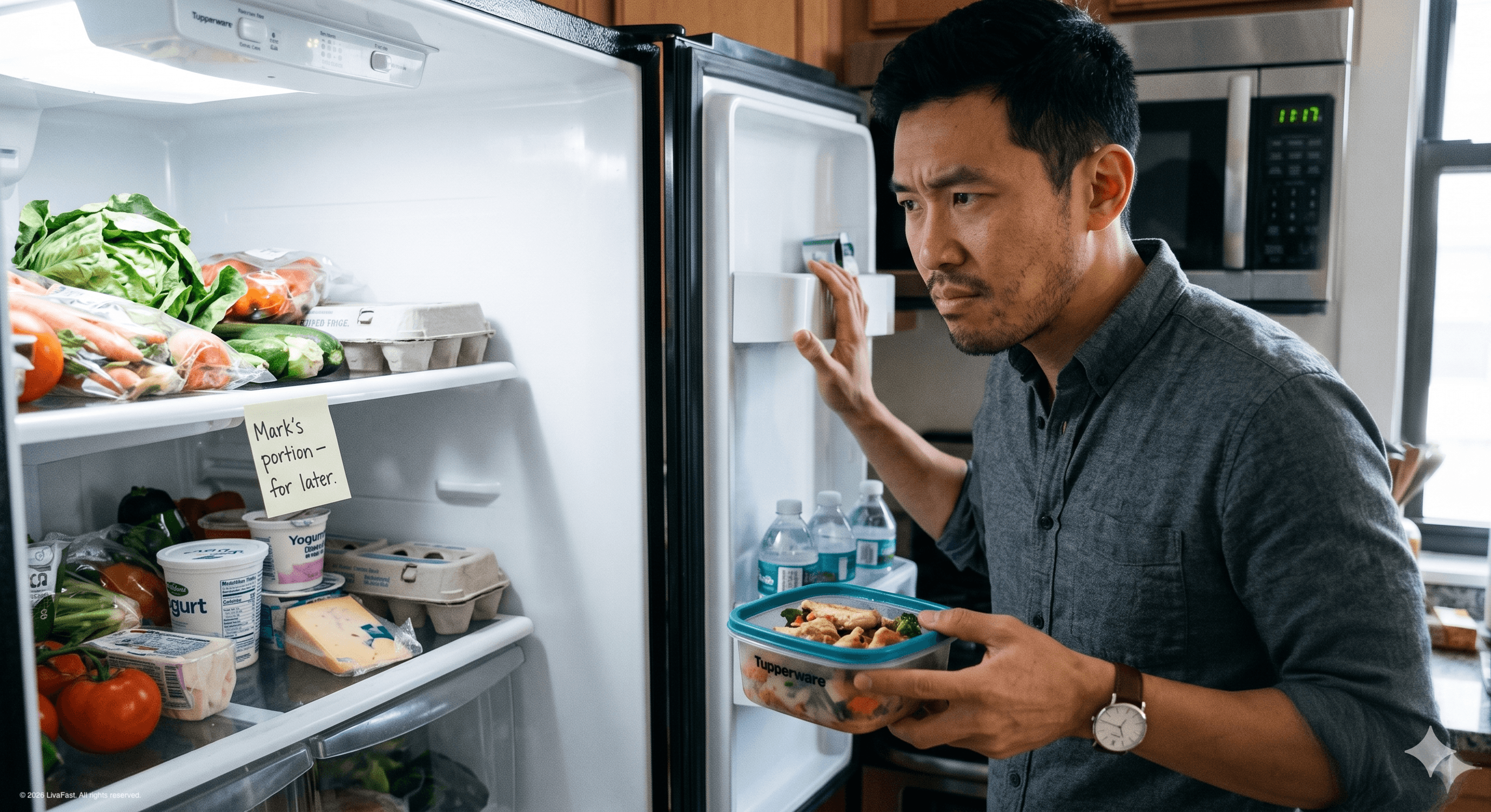
It was 11:17 AM on a Friday, and Mark was standing in front of the open refrigerator like a man at the edge of a cliff, trying to talk himself out of jumping.
He'd made it through fourteen days of 12:12 fasting. Two weeks of closing the kitchen at 8 PM. Two weeks of not eating until 8 AM. It had been — he could admit this now — almost easy. The afternoon brain fog had started to lift somewhere around day five. He'd lost three pounds, which wasn't dramatic but proved the physics were real. His energy had leveled out in a way he hadn't expected. The mornings, which he'd braced for like someone expecting withdrawal, had been fine. Better than fine. He'd felt clearer.
But today the pad thai was in the fridge.
Priya had brought it home last night from the place on South Lamar — the one with the good fish sauce and the noodles that stayed tender even the next day. She'd left him a portion in a glass container, measured out carefully, as if she knew he might need boundaries. Which, apparently, she did.
He'd eaten breakfast at 7:45 AM. Fifteen minutes early. Not a big deal, he'd told himself. Just a buffer. Eggs, toast, coffee. And then at 10:50 AM he'd made the mistake of opening Instagram and seeing Jake's lunch — a poke bowl with avocado and sesame oil and sunflower seeds, photographed from directly above like it was a small edible sunset. Jake ate at noon. Jake was on 16:8. Jake had lost thirty pounds and looked like he'd been doing this his whole life.
At 11 AM, Mark had opened the fridge "just to see."
He wasn't hungry. His body wasn't asking for food. He'd eaten two hours ago. But his brain — his brain was a different organ entirely, and it had spotted the pad thai container the way a dog spots a squirrel: with total focus and zero capacity for negotiation.
It's only fourteen hours instead of sixteen, his brain offered. You've been good for two weeks. You could do 14:10. You could do 16:8 tomorrow. You could —
"No," Mark said out loud, to the refrigerator, in his empty kitchen, at 11:03 AM on a Friday.
He shut the fridge.
His phone buzzed. Slack message from his boss: "Quick call at 11:30?"
Of course. Eleven-thirty. Right in the window where the hunger was loudest and the willpower was thinnest. Nothing like a pointless work call to pair with caloric desperation. Mark replied with a thumbs up and sat at the kitchen table, trying to will his stomach quiet.
At 11:16, he broke.
He opened the container and ate half the pad thai standing at the counter. The noodles were still good — the sauce had marinated into them overnight, the basil was fragrant, the chicken was tender. He chewed slowly, trying to be mindful, trying to frame this as an intentional choice rather than a collapse. But the flavor had a bitter edge that had nothing to do with the food. He'd lasted fourteen days and then folded for rice noodles.
When his boss called at 11:30, Mark answered with his mouth working through the last bite. The call lasted forty minutes and accomplished nothing, which somehow made the pad thai taste like defeat.
That evening, Mark sat on the couch with Biscuit's head on his thigh and his phone in his hand. The dog had a talent for materializing whenever Mark's mood shifted — some canine barometer that detected emotional weather changes and responded by placing his warm skull exactly where it was needed.
Mark was scrolling through the fasting research he'd bookmarked, but this time he was reading with different eyes. Not looking for the best protocol. Looking for something else. Something that explained why he'd broken today, and whether breaking meant he'd chosen wrong.
He found it on a comment thread first — someone who'd written: "I failed at 16:8 so many times before I realized that maybe I just don't do well with 16:8. Switched to 14:10 six months ago. Never looked back."
Then he found it in the literature. A hepatology study comparing fasting protocols across MASLD patients. The results made him sit up straighter.
All of them worked. Every single one. 12:12, 14:10, 16:8, 5:2 — each protocol showed improvements in liver fat, in ALT levels, in metabolic markers. The differences between them were real but modest. Maybe 10–15% more liver fat reduction as you moved from 12:12 to 16:8. Meaningful in a spreadsheet. Nearly invisible in a body.
But buried in the abstract was a sentence that stopped him cold:
"Consistency in a sustainable protocol exceeds the benefits of sporadic adherence to a more aggressive intervention."
He read it twice. Then a third time.

Translation: sticking with 12:12 for twelve weeks would generate better results than starting 16:8, white-knuckling it for four days, falling back to 12:12, trying again, burning out, and quitting entirely. The math was brutal and simple. Consistency compounded. Inconsistency cancelled itself out.
Mark opened his notes app and re-read what he'd written two weeks ago: "Week 1: 12:12 Fast. Start tomorrow. Close kitchen at 8 PM." He'd written it with such certainty, as if there was one protocol, one correct answer, and finding it was the hard part. The way he'd approach a marketing campaign — find the highest-converting creative and scale it.
But bodies weren't campaigns. People weren't audiences. And the highest-converting protocol was worth nothing if the audience abandoned it after fourteen days because of pad thai.
He texted Dave: "Question. Is 14:10 worse than 16:8? Like, is there a research reason to force 16:8 if 14:10 is more sustainable for me?"
Dave responded in under a minute: "No. Look up dose-response curves on TRE. The difference between 14:10 and 16:8 is maybe 10% more benefit. The difference between consistency and quitting is 100%. Do the one you can actually do."
Mark set the phone down and opened his laptop. This time he was reading the research with a different lens — not hunting for the optimal protocol, but looking for a progression strategy. A ladder he could climb instead of a wall he had to scale.
He found it in a small study — forty-seven MASLD patients using a progressive fasting protocol. The design was simple:
Weeks 1–2 at 12:12. Weeks 3–4 at 14:10. Weeks 5–6 at 16:8.
Each phase shifted the eating window by one hour. Close the kitchen at 8 PM, then 7 PM, then 6 PM. No dramatic leaps. No heroics. Just a two-week adaptation at each level before stepping up.
The results: 94% adherence through all six weeks. Significant reductions in ALT, AST, and triglycerides. And the number that mattered most — nobody quit.
Ninety-four percent. Compared to 60–70% completion when people jumped straight to 16:8. The cost of the extra two weeks of gentler fasting was paid back many times over in sustained behavior change.
Mark read the paper three times.
Here's what clicked: there was no single best protocol. There was a best approach. Start where you can succeed. Build the habit. Then graduate. The research wasn't ranking 12:12 as good, 14:10 as better, and 16:8 as best. It was ranking consistency as excellent and perfection-abandoned-after-two-weeks as catastrophic.
He texted Jake: "Quick question. Did you actually start at 16:8, or did you build up?"
"Honestly? Was supposed to start at 12:12 but got impatient. Jumped to 16:8 after three days. It sucked for two weeks. Almost quit multiple times. Would've been smarter to build up lol."
There it was. Jake's success wasn't because of his approach. It was despite it. He'd forced through discomfort by sheer stubbornness, not because forcing was optimal. Mark didn't have Jake's stubbornness. He had pad thai.
He opened his calendar and wrote a new plan:
Weeks 1–2 (done): 12:12, kitchen closes at 8 PM. Weeks 3–4: 14:10, kitchen closes at 7 PM. Weeks 5–6: 16:8, kitchen closes at 6 PM. Weeks 7–12: maintain 16:8, or explore 18:6 if 16:8 becomes easy.
The revelation was small but it landed hard: he was allowed to have a progression strategy. He didn't have to achieve the final form of fasting by Monday. He had permission to build — and the research said building was actually better than jumping.
That night, Mark prepped grilled chicken and roasted broccoli for the week. He put the remaining pad thai in a container labelled "Priya's" and set his fasting app's target to fourteen hours — his goal for week three.
He didn't feel like he'd failed today. He felt like he'd learned what he actually needed: not a protocol, but a progression. Not a sprint to sixteen hours, but a sustainable climb. And somewhere in the research — in that single sentence about consistency exceeding aggressiveness — he'd found the permission to be honest about what he could sustain.
Tomorrow, he'd close the kitchen at 8 PM for one more week. Then 7 PM. Then 6 PM. And somewhere along the way, the metabolic switch would become so routine that the pad thai wouldn't even register.
Biscuit sighed on his thigh, the deep exhale of a dog who'd been patient through an entire emotional arc and was ready for bed.
"Yeah," Mark said. "Me too."
Track this in LivaFast
Your FIB-4 score updates automatically from your labs.